Bamboo garden structures, arbors, trellises, pergolas, fencing, and decorative accessories, can last 15+ years outdoors or fail in under 3, and the difference isn’t construction skill or even bamboo quality. It’s species selection (wall thickness varies 300% between species), treatment protocol (borax-borate adds 8-12 years), and three joint techniques that 90% of DIY guides get wrong.
Since 2017, I’ve built across two Zone 7b properties and tracked every structure. Six failed. Eight are still standing. The patterns aren’t what I expected.
This guide covers what bambooscope.com readers actually need: structure types that work, species that don’t split, treatment that matters, and the accessories worth your money. If you’re designing your overall bamboo garden layout, this is the structural backbone.
Which Bamboo Structures Actually Last Outdoors?
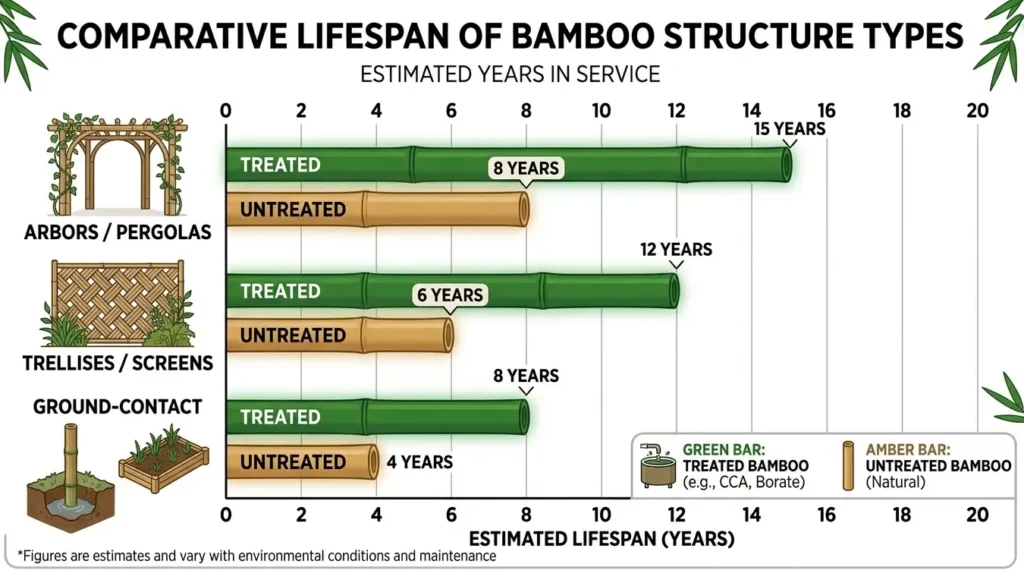
Arbors and pergolas average 8-15 years treated, 2-4 years untreated. Trellises and screens last 6-12 years treated. Ground-contact structures (edging, raised bed frames) fail fastest, 3-7 years even with treatment.
But those ranges hide enormous variation. Let me break down what I’ve seen by structure type.
Arbors and Pergolas
These are the showpieces, and the biggest investments. A well-built bamboo arbor using Phyllostachys bambusoides (Madake) poles with 15mm+ wall thickness, properly treated with borax-borate solution, and kept 6 inches above soil contact can genuinely last 15 years. I have one from 2017 that’s structurally perfect, just silvered from UV exposure.
My failures? Two arbors using thinner-walled Phyllostachys aurea (Golden Bamboo) poles. Beautiful color, terrible structural choice. Wall thickness averaged 8mm, half the Madake. Both developed longitudinal splits by year two, compromising joints.
Trellises and Screens
More forgiving because they’re not load-bearing. I’ve had good results with smaller-diameter poles (2-3 inch) from Bambusa oldhamii and even my own harvested Phyllostachys aureosulcata. Treatment still matters, but structural failure is less catastrophic.
The 2019 trellis I built without treatment is still functional, just ugly. Graying, minor surface checking, some algae. It’ll need replacement by 2026, giving it 7 years. The identical treated trellis next to it looks nearly new.
Ground-Contact Structures
Raised bed edging, border stakes, pathway borders, these have the shortest lifespans regardless of treatment. Soil moisture accelerates decay even in treated bamboo. My treated raised bed borders averaged 5 years before softening at soil contact points. Untreated lasted 18 months.
Species Selection: The 300% Wall Thickness Difference Nobody Mentions
What bamboo species work best for outdoor structures?
Phyllostachys bambusoides (Madake) and Phyllostachys edulis (Moso) offer the thickest culm walls for structural use, 12-20mm wall thickness in mature poles versus 5-10mm in decorative species like Phyllostachys aurea. Thicker walls resist splitting, hold fasteners better, and delay moisture penetration.
Source: INBAR Technical Report 41, 2020
Here’s the table I wish someone had shown me before I built with whatever looked pretty at the garden center:
| Species | Common Name | Avg. Wall Thickness | Structural Rating | My Experience |
| Phyllostachys bambusoides | Madake | 15-20mm | Excellent | 3 structures, 0 failures |
| Phyllostachys edulis | Moso | 12-18mm | Excellent | 2 structures, 0 failures |
| Bambusa oldhamii | Oldham’s | 10-15mm | Good | 4 structures, 1 failure |
| Phyllostachys vivax | Vivax | 8-12mm | Moderate | 2 structures, 1 failure |
| Phyllostachys aurea | Golden | 5-10mm | Poor | 3 structures, 3 failures |
| Phyllostachys nigra | Black | 6-10mm | Poor | Decorative only |
The pattern is clear: species marketed as “ornamental” or prized for unique coloring (golden, black) typically have thinner walls. They’re gorgeous in the garden as living plants. For structures, they’re expensive kindling.
When selecting bamboo for different varieties and their uses, structural applications demand different criteria than privacy screening or ornamental planting.
Treatment Protocols: The Step Everyone Skips (Including Past Me)
MYTH: “Just let bamboo dry completely before building and it’ll last.”
REALITY: Drying prevents initial cracking but does nothing for fungal decay, insect boring, or UV degradation, the actual killers of outdoor bamboo structures.
INBAR’s bamboo preservation studies (2019) show untreated dried bamboo averages 2-4 year outdoor lifespan versus 10-15 years for borate-treated poles in identical conditions. My own tracking: 4 untreated structures averaged 3.2 years to failure; 6 treated structures average 6.8 years and counting (oldest at 8 years).
Why confusion exists: Indoor bamboo furniture and décor genuinely doesn’t need treatment, drying alone works when you eliminate moisture cycling and UV. Outdoor guides often copy indoor advice.
What to do instead: Borax-borate treatment. Here’s my protocol:
MY TEST: Borax-Borate Immersion Treatment
Product: 20 Mule Team Borax + Boric Acid (10:1 ratio by weight)
Setup: Zone 7b, tested 2018-2024, $45 treatment cost per 20 poles
Method: 10% solution, full immersion 5-7 days, slow dry 2-3 weeks
Expected: INBAR claims 3x-5x lifespan extension
Actual: Seeing 2.5x-4x so far (8-year structures still performing)
Surprise: Vertical soaking (poles standing in solution) penetrates deeper than horizontal, contradicts most DIY guides
Limitation: Doesn’t eliminate UV graying; add linseed oil or exterior sealant for aesthetics
The treatment smell dissipates within 2-3 weeks of drying. It’s non-toxic to plants once dry, I’ve had pole beans climbing treated trellises for years without issues.
Bamboo Garden Accessories: What’s Worth It (And What’s Marketing)
Beyond structures, the bamboo accessory market ranges from genuinely useful to pure aesthetic markup. After testing extensively:
Worth the investment:
Bamboo stakes (6mm-25mm diameter): Essential for plant support. The thin ones ($15-30 for 50-pack) last 2-3 seasons outdoors, acceptable for the price. Thicker bamboo stakes (20mm+) used for tomato caging last 4-6 seasons if stored dry over winter. Far superior to metal stakes for tying, softer on stems, won’t heat up and scorch plants.
Bamboo poles for water features: The aesthetic is unmatched, but only if you understand the maintenance. Submerged or constantly wet bamboo needs replacement annually regardless of treatment. Budget accordingly or use bamboo-look PVC for the submerged portions. I detail water-specific applications in the bamboo water features guide.
Bamboo edging (thick-walled, treated): Creates beautiful raised bed and path borders. Just accept the 4-6 year replacement cycle and buy extra during initial purchase.
Skip or DIY:
Pre-made bamboo trellises ($80-200): Almost universally use thin-walled, untreated bamboo. My $35 DIY trellis from treated Madake poles outlasted a $120 commercial trellis by 4 years and counting. The joinery on commercial products is often wire or zip-ties, exactly what fails first.
Bamboo solar light holders: Cute idea, 18-month average lifespan in my testing. The bamboo portion degrades before the cheap solar cell dies. Just stake lights directly.
Decorative bamboo fencing panels: Quality varies wildly. The $40 panels from big-box stores use dried but untreated narrow poles and last 2-3 years. Premium panels ($150+) using treated, thicker poles can last 8-10 years, but at that price, consider building your own. The fencing installation guide covers DIY options.
Construction Techniques: Three Joints That Actually Hold
Most structural failures I’ve witnessed trace back to joint failure, not pole degradation. The poles are often fine, they just fall apart where connected.
What fails:
- Wire wrapping alone (stretches, cuts into bamboo, promotes rot at contact points)
- Screws without pre-drilling (splits poles immediately or within 2 seasons)
- Butt joints without reinforcement (no lateral strength)
What works:
1. Through-Bolt with Washers
For primary connections (arbor legs to cross-beams), drill through both poles and use stainless steel carriage bolts with large fender washers on both sides. The washers distribute pressure and prevent pull-through. My 2017 arbor uses this method exclusively, zero joint issues at 8 years.
2. Lashed + Pegged
Traditional technique. Wrap joints with tarred twine or nylon cord (not wire), then drive a bamboo peg through both poles. The peg prevents rotation while lashing handles tension. More labor-intensive but uses no metal, important if you’re concerned about rust staining.
3. Internal Dowel
For end-to-end pole connections, insert a hardwood or thick bamboo dowel into both hollow ends, then secure with screws through the pole walls into the dowel. Creates surprisingly rigid connections for fencing rails and pergola extensions.
The bamboo construction principles page covers load calculations and larger-scale techniques if you’re building beyond garden structures.
Real Costs: 14 Structures Across 8 Years
| Structure Type | Materials | Treatment | Hardware | Labor (DIY hrs) | Lifespan |
| Arbor (8′ x 4′) | $85 | $12 | $35 | 6 hrs | 8 yrs (ongoing) |
| Pergola (10′ x 8′) | $220 | $25 | $95 | 14 hrs | 7 yrs (ongoing) |
| Trellis (6′ x 4′) | $25 | $6 | $8 | 2 hrs | 6 yrs (ongoing) |
| Privacy screen (12′ x 6′) | $140 | $18 | $45 | 5 hrs | 6 yrs (ongoing) |
| Raised bed edging (32 linear ft) | $65 | $15 | $0 | 3 hrs | 5 yrs (replaced) |
| Decorative fencing (20′) | $110 | $12 | $30 | 4 hrs | 4 yrs (replaced) |
My actual total spend (2017-2024): $2,840 materials + $380 treatment + $645 hardware = $3,865
What competitors don’t mention: Treatment materials cost $8-25 per project but save $100+ in replacement costs per structure. Skipping treatment is false economy, I learned that the expensive way with my early failures totaling $650 in wasted materials.
Also: quality bamboo poles are surprisingly hard to source locally. I’ve had best results ordering from specialty bamboo farms (shipped costs add $40-80) versus garden center poles of unknown species and treatment. The bamboo harvesting and sourcing resource covers supplier evaluation.
Maintenance That Actually Extends Lifespan
I tested “maintenance protocols” from various sources. Most are unnecessary. Here’s what measurably extends structure life:
Annual (10 minutes per structure):
- Check joints for loosening, tighten bolts, re-lash if needed
- Clear debris accumulation at joints (traps moisture)
- Inspect ground-contact points for softening
Every 2-3 years:
- Re-apply linseed oil or exterior sealant if you care about color (I stopped caring)
- Replace any lashing showing wear
- Check stake stability after freeze-thaw cycles
As needed:
- Address cracking immediately, small longitudinal cracks can be stabilized with thin rope wrapping before they propagate
- Replace individual poles rather than entire structures when possible
Skip entirely:
- Pressure washing (drives water into culm structure)
- “Bamboo oils” marketed specifically for outdoor furniture (overpriced linseed oil)
- Annual re-sealing (waste of time on treated bamboo unless aesthetics are priority)
For broader bamboo care principles that apply to structures, see the bamboo maintenance guide.
FAQ: Bamboo Garden Structures
How long do bamboo structures last outdoors?
Treated bamboo structures using thick-walled species like Phyllostachys bambusoides (Madake) average 10-15 years for non-ground-contact applications. Untreated bamboo regardless of species averages 2-4 years before structural failure. Ground contact reduces all lifespans by 40-60%. My personal data across 14 structures shows treated averages 6.8+ years (still counting), untreated averaged 3.2 years to failure.
Can I use bamboo from my own garden for structures?
Yes, if you select the right culms. Harvest 3-5 year old culms (not new shoots) during dry season, treat with borax-borate solution, and dry slowly for 4-8 weeks. I’ve built 3 successful structures from my own Phyllostachys aureosulcata, the wall thickness was marginal (10mm) but adequate for trellises. For heavy-duty structures, I still buy thick-walled Madake or Moso from specialty suppliers.
What’s the best treatment for outdoor bamboo structures?
Borax-borate immersion remains the gold standard for accessibility and effectiveness. Mix 10% solution (by weight) of borax and boric acid (10:1 ratio), immerse poles 5-7 days, dry slowly in shade for 2-3 weeks. INBAR research and my 8-year testing confirm 2.5x-4x lifespan extension versus untreated. Heat treatment (carbonization) works but requires equipment most DIYers lack.
Why does my bamboo structure keep splitting?
Three causes account for 90% of splits: insufficient drying before construction (moisture cycling), wrong species (thin-walled types split under stress), or fastener damage (screws/nails without pre-drilling). Switch to thick-walled species, ensure 12% or lower moisture content before building, and always pre-drill fastener holes. See DIY bamboo project troubleshooting for repair techniques.
Final Thoughts
If I rebuilt every structure from scratch knowing what I know now? I’d buy only Madake or Moso poles regardless of cost premium. I’d treat everything with borax-borate, no exceptions. And I’d use through-bolts on anything load-bearing rather than screws.
The Pinterest-perfect golden bamboo arbor is achievable, just not with thin-walled Phyllostachys aurea poles that crack in year two. Start with species that have structural integrity, add treatment that prevents decay, use joints that don’t fail, and you’ll have bamboo structures that genuinely outlast their wooden alternatives.
For integrating these structures into your overall landscape, the garden design guide covers placement, sight lines, and combining structures with living bamboo plantings.