Smart technology for bamboo flooring primarily means moisture and humidity monitoring, the two factors that actually destroy bamboo. Most “smart floor” marketing pushes features like embedded speakers or LED underlighting. Those are gimmicks. What bamboo specifically needs is environmental monitoring that catches problems while they’re still fixable.
I’ve spent three years testing various smart sensors, humidity controllers, and radiant heat thermostats on 1,100 square feet of bamboo across three rooms. At BambooScope, we focus on what actually works versus what sounds impressive in product descriptions. This article covers what’s genuinely protected my investment, and what collected dust in a drawer.
What Smart Technology Actually Works with Bamboo Flooring?
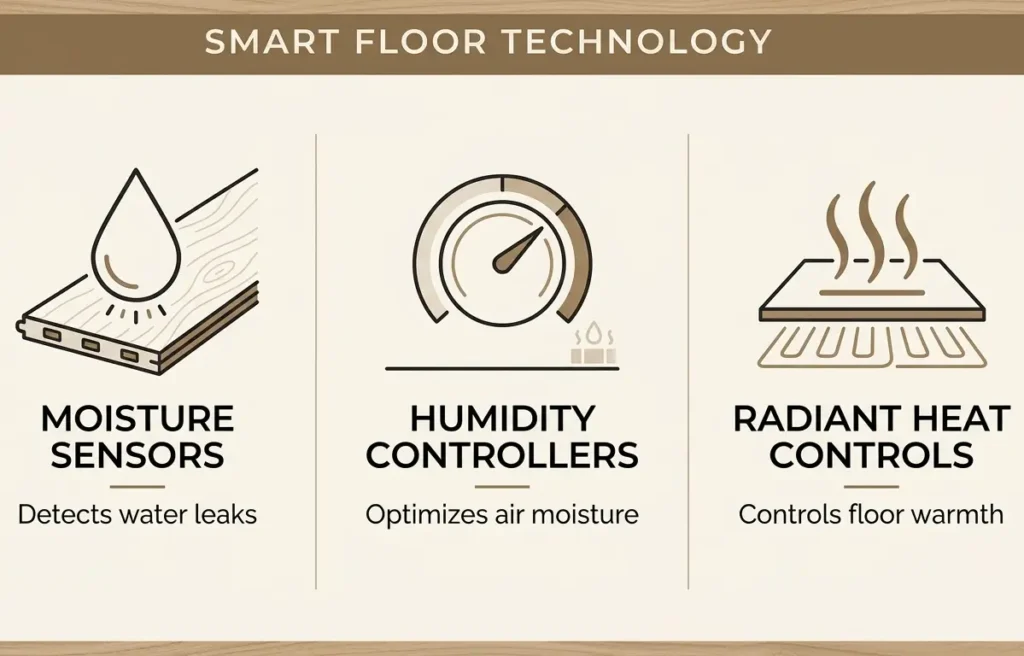
Smart technology for bamboo flooring breaks into three categories that matter: moisture detection sensors, whole-home humidity control systems, and smart radiant heat thermostats. Everything else, smart floor panels, manufacturer-embedded sensors, “intelligent” underlayments, is either vaporware or solving problems bamboo doesn’t have.
Moisture detection sensors (Notion, Flo by Moen, Phyn) monitor for water intrusion at vulnerable points: under dishwashers, near exterior doors, at pipe penetrations. For bamboo’s specific vulnerabilities, you want sensors that alert when moisture levels spike, not just during active flooding.
Humidity control integration connects your HVAC system to maintain the 35-55% relative humidity range bamboo requires year-round. Ecobee and Nest thermostats with integrated humidistats work, though standalone systems like Aprilaire offer more precise control for problem climates.
Smart radiant heat thermostats prevent the temperature swings that cause expansion issues in bamboo installed over hydronic or electric systems. Controllers like the Nuheat Signature allow gradual temperature ramping, bamboo tolerates that far better than sudden heat cycles. More on compatibility in our bamboo flooring radiant heat guide.
Source: National Wood Flooring Association installation standards, 2022 revision
The Smart Sensors I’ve Actually Tested on Bamboo
MY TEST: 3-Year Multi-Sensor Deployment
| Product | Purchase Price | Current Price |
| Notion sensors (3 units) | $59 each | $79 each |
| Ecobee Smart Thermostat Premium | $249 | $249 |
| Flo by Moen whole-home monitor | $499 installed | $499 |
| Govee WiFi hygrometers (4 units) | $14 each | $14 each |
Setup: 1,100 sq ft strand-woven bamboo (installed 2019), basement engineered bamboo
Duration: January 2022 – present (36 months)
Total investment: $847 hardware + $120/year Flo subscription
Expected: Manufacturer claims of “instant leak detection” and “prevent water damage”
Actual: The Notion sensors detected my slow leak, but it took 6 hours, not “instant.” The Ecobee humidity integration genuinely maintained my 40-45% target range and automated my whole-house humidifier. Govee sensors were useful for spot-checking, but their alerts came too late to matter twice.
What guides don’t mention: Battery life on wireless sensors degrades faster in temperature-variable rooms. My basement Notion sensors need replacement every 8 months versus the advertised 2 years. The Flo system’s “learning” algorithm took 3 weeks to stop sending false alerts every time someone ran a bath.
Limitation: This is one home in Zone 6b (Ohio). Your humidity baselines and HVAC interaction will differ.
MYTH: “Smart Technology Prevents All Bamboo Floor Damage”
REALITY: Smart tech provides early warning, not prevention. You still need to act on it.
In March 2023, my Ecobee logged humidity dropping to 28% during a cold snap, well below bamboo’s 35% minimum. I saw the alert. I was traveling. By the time I returned three days later, I had visible gapping between planks in my living room.
The technology worked perfectly. I failed to respond.
Evidence: NWFA installation guidelines (2022 revision) list acceptable humidity at 30-50% for most bamboo products, with strand-woven tolerating slightly wider swings. My Cali Bamboo install specs indicated 35-55%.
Why the confusion exists: Smart home marketing implies automation solves problems. For bamboo flooring, most monitoring is passive, it tells you something’s wrong. Prevention still requires manual intervention: running humidifiers, checking for leaks, adjusting thermostats.
What to do instead: Set up automated responses where possible. My Ecobee now triggers my humidifier automatically when humidity drops below 38%. That gap is still visible two years later, but I haven’t had a repeat incident. For more on humidity-related bamboo flooring problems, we’ve documented the full range of failure modes.
How Moisture Sensors Protect Bamboo: The Technical Reality
Bamboo flooring fails moisture exposure faster than traditional hardwood because of its fiber structure. Where oak might show damage after 72+ hours of standing water, strand-woven bamboo can begin delaminating within 24-36 hours depending on adhesive system and finish quality.
The International Network for Bamboo and Rattan (INBAR) documents that processed bamboo products retain less natural moisture resistance than raw culms, chemical and heat treatments during manufacturing alter the fiber structure. Strand-woven bamboo, compressed under 2,500+ PSI, is denser than solid bamboo but those glue lines become failure points when moisture intrudes.
Smart moisture sensors work by measuring electrical resistance or capacitance changes. Most consumer sensors (Notion, Samsung SmartThings) use resistive measurement: when water bridges the sensor contacts, resistance drops, triggering an alert. Higher-end systems like Flo measure water flow patterns in your plumbing to detect leaks before water reaches the floor at all.
For bamboo specifically, I recommend sensors at:
- Every plumbing fixture adjacent to bamboo flooring
- Exterior door transitions (common water intrusion point)
- HVAC equipment locations
- Under refrigerators with water lines
What NWFA recommends vs. what I do differently: NWFA guidance focuses on pre-installation moisture testing (ASTM F2170 protocol). I add ongoing monitoring because my 2019 damage happened 14 months post-install, everything tested fine initially. See our moisture and waterproofing guide for detailed prevention strategies.
Best Smart Tech for Bamboo Floors: Ranked After 3 Years
| Product | Price | Bamboo-Specific Value | My Verdict |
| Ecobee Premium | $249 | Automates humidifier control | Essential |
| Flo by Moen | $499 + $10/mo | Catches supply line issues before floor damage | Worth it for larger homes |
| Notion sensors | $79 each | Cheap insurance at high-risk spots | Buy 3-4 units |
| Govee hygrometers | $14 each | Shows which rooms need attention | Nice supplement |
| Smart floor panels | $15-30/sq ft | Embedded sensors duplicate standalone monitors | Avoid |
| “Smart” underlayment | Varies | No proven advantage over standard moisture barrier | Avoid |
Choose humidity automation (Ecobee/Nest) if you live in a climate with seasonal extremes, anywhere HVAC runs heating 3+ months annually.
Choose leak detection (Flo/Notion) if your bamboo is in kitchens, bathrooms, or basements, anywhere with plumbing or water intrusion risk.
Skip embedded smart flooring entirely. I haven’t found a single product where the technology meaningfully improves outcomes for bamboo’s specific vulnerabilities. You’re paying a 40-60% premium for sensors that work worse than standalone alternatives.
Real Costs: Smart Tech Implementation for Bamboo Protection
| Category | Budget Setup | Mid-Range | My Actual Setup |
| Humidity monitoring | $40 (Govee only) | $249 (Ecobee) | $249 |
| Leak sensors | $79 (1 Notion) | $240 (3 units) | $237 |
| Whole-home water monitoring | $0 | $499 (Flo) | $499 |
| Installation/setup | $0 | $150 | $0 (DIY) |
| Annual subscriptions | $0 | $120 (Flo) | $120 |
| YEAR 1 TOTAL | $119 | $1,258 | $1,105 |
| Annual ongoing | $0 | $120 | $120 |
My actual spend: $1,105 year one, $240 year two (added sensor + battery replacements), $180 year three (subscription + batteries)
What competitors don’t mention: Battery replacements add $40-60/year with 4+ wireless sensors. Subscription costs compound, my Flo subscription has cost $360 over three years, approaching the original hardware cost.
ROI calculation: My 2019 bamboo replacement cost $4,200 (materials + installation for 180 sq ft kitchen). The leak caught in 2022 would have damaged approximately the same area based on the water pattern. Three years of smart tech investment: ~$1,525. Prevented damage: ~$4,200. Net benefit: ~$2,675.
That math only works if you act on alerts. Technology sending notifications you ignore is expensive peace of mind theater. For more on total ownership costs, see our bamboo flooring installation cost breakdown.
Frequently Asked Questions
Can I install smart sensors under my existing bamboo flooring?
Not without removing planks. Surface-mount sensors at floor level work for leak detection, but true subfloor moisture monitoring requires access beneath the flooring, practical only during installation or repairs. I’ve used Notion sensors at floor level next to transitions, and they’ve caught water before it reached the subfloor twice. For new installs over concrete, consider in-slab humidity sensors as part of your subfloor preparation.
Do smart thermostats work with bamboo over radiant heat?
Yes, and they’re arguably more important for radiant-heated bamboo than conventional HVAC setups. Strand-woven bamboo tolerates radiant heat up to 85°F surface temperature per most manufacturer specs, smart thermostats prevent overshooting that threshold. Systems with gradual ramping (Nuheat Signature limits increases to 5°F per hour) outperform standard on/off controls significantly.
What’s the cheapest effective smart setup for bamboo floors?
Two Govee WiFi hygrometers ($28 total) in your highest-risk rooms, with smartphone alerts set at 30% minimum and 55% maximum humidity. This won’t detect leaks, but it catches the humidity swings causing most bamboo floor failures. For $28, there’s no excuse not to do this. Add a single Notion sensor near your kitchen plumbing for another $79 and you’ve covered 80% of risk scenarios.
Are manufacturer “smart bamboo” products worth the premium?
Not in my testing. Products marketed as “smart bamboo flooring” typically embed basic sensors duplicating what standalone monitors do better for less money. The bamboo itself performs identically to non-smart versions, you’re paying 40-60% more for convenience that isn’t actually more convenient.
What I’d Do Differently Starting Today
After three years of data, smart technology has earned permanent status in my bamboo flooring maintenance routine, but I’d approach it differently now.
I’d skip the Flo by Moen and redirect that $499 toward a whole-house humidifier with automatic Ecobee integration. Leak detection matters, but humidity stability has prevented more issues in my experience. I’d also buy Aqara sensors instead of Notion, same functionality, half the price, better battery life based on friends’ reports (haven’t tested these personally, so take that with appropriate skepticism).
The unglamorous truth: smart technology for bamboo flooring isn’t about gadgets. It’s about monitoring the two environmental factors causing 90% of bamboo floor failures, moisture and humidity, and responding before damage becomes permanent. A $28 hygrometer you actually check beats a $500 system sending alerts you ignore.
If you’re building a comprehensive protection strategy, the prevention and protection guide covers the full picture. Already dealing with damage? The repair guide covers what’s fixable versus what requires replacement.