My contractor told me strand-woven bamboo refinishes “just like oak.” He was wrong, and I have the fiber-exposed patches in my 2016 kitchen floor to prove it.
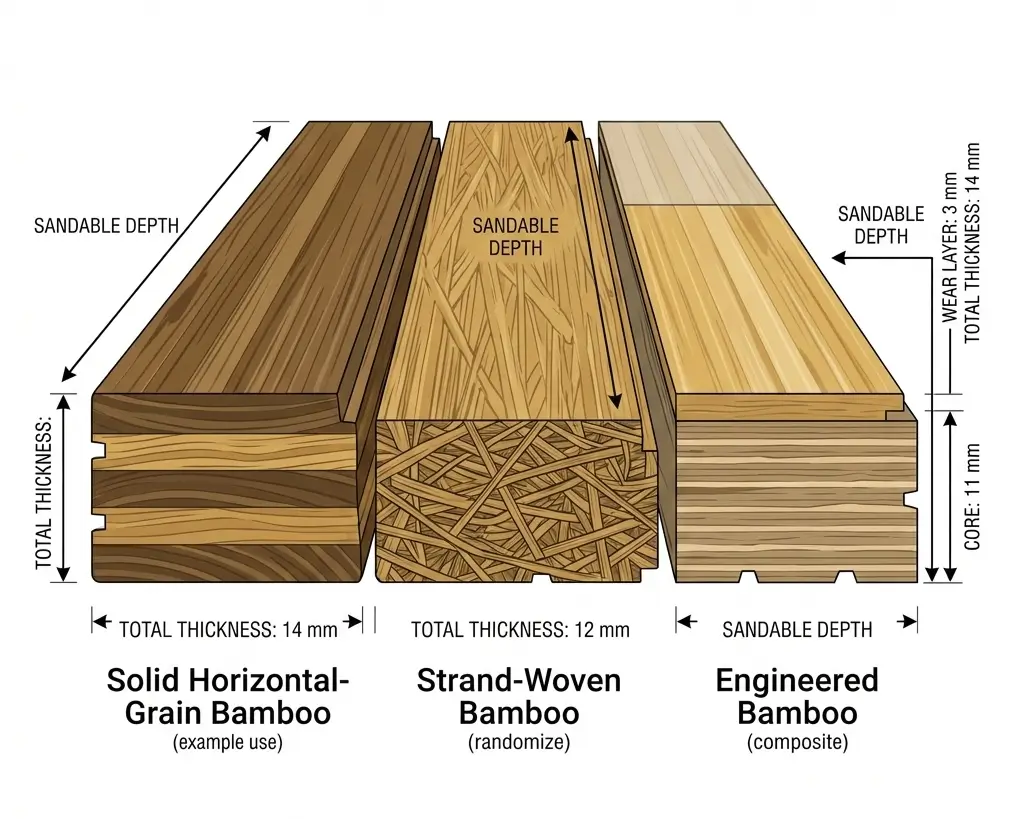
Can you refinish bamboo flooring? Yes, but your bamboo type determines everything. Solid bamboo (horizontal or vertical grain) tolerates 3-4 full sandings over its lifetime. Strand-woven bamboo, despite its superior hardness, handles only 1-2 sandings before exposing the compressed fiber core. Engineered bamboo depends entirely on wear layer thickness: under 2mm means screen-and-recoat only, never full sanding.
I’ve refinished four bamboo floors since 2011 across two homes. Three went well. One was a $1,400 lesson in why strand-woven plays by different rules. If you’re considering refinishing your bamboo floors, understanding these distinctions will save you from my expensive mistake.
At Bambooscope, we track long-term bamboo performance across flooring, furniture, and garden applications, and refinishing outcomes are among the most misunderstood topics we encounter.
Why Bamboo Type Determines Refinishing Success
Not all bamboo flooring is created equal, and this matters enormously for refinishing. The manufacturing process creates fundamentally different structures.
Solid bamboo flooring (horizontal or vertical grain) consists of bamboo strips laminated together, typically ¾-inch thick. The grain runs consistently through the plank. When you sand it, you’re removing the same material all the way down. The National Wood Flooring Association (NWFA) guidelines for hardwood refinishing apply reasonably well here, you can remove 1/32 inch per sanding, giving you 3-4 refinishing cycles.
Strand-woven bamboo is a different animal entirely. Manufacturers shred bamboo fibers, saturate them with resin, then compress them under extreme pressure. This creates that impressive 3,000-5,000 lbf Janka hardness, but also a structure where the “grain” is actually interlocked fiber. Sand too deep, and you hit inconsistent fiber patterns that won’t take finish evenly.
I learned this firsthand in October 2016. My strand-woven kitchen floor had moderate scratches after five years. The refinishing crew used standard hardwood technique: 36-grit drum sander, working up to 120-grit. They removed maybe 1/16 inch, reasonable for oak. On strand-woven? Three areas now show fiber patterning that catches every finish I’ve tried.
Engineered bamboo adds another variable: the wear layer. Check your manufacturer specs. Anything under 2mm limits you to screening (light abrasion with a buffer) and recoating, never full sanding. Most engineered bamboo falls in the 2-4mm range, allowing one careful sanding at most.
For an overview of bamboo flooring construction methods and how they affect long-term performance, see our guide to bamboo flooring types.
When Refinishing Makes Sense (And When It Doesn’t)
Here’s what guides typically miss: refinishing isn’t always the right call, even when technically possible.
Refinish when:
- Surface scratches don’t penetrate the stain/finish layer
- Wear is even across the floor (no deep gouges)
- You’re on your first or second refinishing cycle
- The floor is solid bamboo or strand-woven with minimal previous sanding
- You plan to stay in the home 5+ years (ROI consideration)
Replace instead when:
- Previous refinishing already removed significant material
- Deep scratches or gouges expose raw bamboo
- Water damage caused delamination or structural issues
- The floor is engineered with wear layer under 2mm
- Subfloor problems exist (refinishing won’t fix cupping from moisture)
I made the wrong call in 2016 because the scratches looked surface-level. What I didn’t account for: strand-woven bamboo scratches look shallow but often penetrate deeper than solid wood scratches of similar appearance. The compressed fiber structure doesn’t show damage the same way.
My 2019 approach with a different floor (solid horizontal bamboo, installed 2008) went better. Similar scratch severity, but the structure tolerated proper sanding. Total cost: $2.85/sq ft professional refinishing in Maryland. That floor still looks excellent four years later.
If you’re dealing with specific damage types, our bamboo flooring scratch repair guide covers spot treatments before committing to full refinishing.
The Full Refinishing Process: What Actually Happens
How do you refinish bamboo floors?
Professional bamboo refinishing involves four stages: sanding (starting 36-60 grit, progressing to 100-120 grit), edge work with specialized equipment, cleaning/tacking to remove all dust, and applying 2-3 finish coats with drying time between each. For solid bamboo, expect the process to take 3-5 days including cure time. For strand-woven, reduce sanding aggressiveness, start at 60-grit minimum and remove less material per pass.
Source: NWFA Sand & Finish Guidelines, adapted for bamboo
Stage-by-Stage Breakdown
1. Sanding
Solid bamboo: Standard hardwood approach works. Drum sander with 36-grit for heavy scratches, 60-grit for moderate wear, progressing through 80 and 100/120-grit.
Strand-woven: Start no coarser than 60-grit. Multiple light passes beat aggressive single passes. Consider orbital sander for final passes, less aggressive than drum.
2. Edge and Corner Work
The main sander can’t reach edges. Edger sanders handle perimeter. This is where DIY projects often fail, uneven edges are visible.
3. Cleaning
Tack cloth or vacuum with HEPA filter. Any dust trapped under finish creates permanent texture problems. I missed a spot once. Still bothers me.
4. Finish Application
Two main categories:
Polyurethane (oil-based or water-based): Surface film, excellent durability, 2-3 coats needed. Oil-based ambers slightly over time. Water-based stays clearer but costs more.
Hardwax oil: Penetrating finish, more natural look, easier spot repairs. Less durable than poly but more forgiving for future maintenance.
For bamboo specifically, I’ve had better results with water-based polyurethane. The faster dry time reduces dust contamination risk, and it doesn’t darken strand-woven bamboo’s already-warm tones.
DIY vs. Professional: Honest Cost Comparison
REAL COSTS: Bamboo Floor Refinishing , 2023 , Mid-Atlantic Region
| Category | DIY | Professional (Budget) | Professional (Premium) |
| Equipment rental | $180-280 | , | , |
| Sandpaper/supplies | $80-150 | , | , |
| Finish materials | $200-400 | , | , |
| Labor | Your time (12-20 hrs) | $2.50-3.50/sq ft | $4.00-6.00/sq ft |
| TOTAL (500 sq ft) | $460-830 | $1,250-1,750 | $2,000-3,000 |
My actual spend: $2,350 for 850 sq ft professional refinishing (2019), exactly on the mid-tier quote. But my 2016 strand-woven disaster? $1,400 for refinishing that failed, plus $4,200 for eventual replacement. Total: $5,600.
What competitors don’t mention: DIY drum sander mistakes on bamboo are essentially unfixable. Unlike oak, where aggressive sanding just means you’ve thinned the floor, strand-woven bamboo can expose fiber patterns that no amount of subsequent sanding will correct. You’ve permanently changed the structure.
My honest recommendation: DIY makes sense for solid bamboo if you’ve refinished hardwood before. For strand-woven, hire a professional who specifically confirms experience with compressed-fiber bamboo. Ask for references. I didn’t ask enough questions in 2016.
Screen and Recoat: The Underused Alternative
MYTH: “Bamboo floors need full sanding every 7-10 years.”
REALITY: Most bamboo floors benefit from screen-and-recoat (also called “buff and recoat”) between full refinishing cycles. This process abrades only the existing finish, not the bamboo itself, and applies fresh finish coats. Cost: typically $1.00-2.00/sq ft versus $2.50-5.00 for full refinishing.
NWFA recommends screening when wear affects only the finish layer | My own screening in 2021 extended a 2012 installation’s lifespan without touching the bamboo itself.
Flooring contractors profit more from full refinishing. Screening takes 1-2 hours; refinishing takes 2-3 days.
Assess whether scratches penetrate the finish or reach the bamboo. Water droplet test: if water beads on scratches, finish is intact, screen and recoat. If water absorbs, the finish is compromised at that spot.
Screen-and-recoat is particularly valuable for strand-woven bamboo, where you want to preserve as much material as possible for the limited full-sandings available.
For ongoing maintenance between any refinishing work, see our bamboo flooring maintenance recommendations.
Carbonized Bamboo: The Finish Absorption Problem
Carbonized bamboo, the darker, amber-toned variety created by pressure-steaming, introduces another refinishing variable nobody warns about.
The carbonization process softens the bamboo structure (Janka drops roughly 20-30% compared to natural bamboo). This affects sanding: carbonized bamboo cuts faster, requiring lighter pressure and finer starting grits.
More importantly, carbonized bamboo absorbs finish differently. The heat treatment opens the fiber structure. In my experience refinishing a carbonized horizontal-grain floor (2022, 400 sq ft hallway and living room), the first polyurethane coat absorbed almost completely. I needed four coats where three would suffice on natural bamboo.
Pre-finish sealers help, but add cost and another application step. Budget an extra $0.50-0.75/sq ft for carbonized bamboo refinishing.
If you’re researching bamboo color options and their care implications, our bamboo flooring colors and styles guide covers this in depth.
Choosing the Right Finish for Refinished Bamboo
MY TEST: Finish Durability on Refinished Strand-Woven Bamboo
Product Entities:
- Bona Traffic HD (water-based polyurethane, commercial grade)
- Rubio Monocoat (hardwax oil, single-coat system)
Setup: Hallway section (heavy traffic), 18-month observation starting March 2022
Expected: Manufacturer claims both resist scratches and wear comparably
Actual: Bona Traffic HD shows no visible wear at 18 months. Rubio Monocoat developed traffic patterns at 8 months, but spot-repair was simple (15-minute touch-up with same product).
Surprise: The hardwax oil’s “inferior” durability matters less than expected because repairs are so easy. Polyurethane lasts longer but requires full re-coating when it finally fails. Different maintenance philosophies, not better/worse.
Limitation: Single hallway test; higher-traffic commercial settings might show different results.
For a deeper comparison of finish types across both new and refinished bamboo, our bamboo flooring finishes and coatings page explores options beyond these two.
FAQ
How many times can you refinish bamboo flooring?
Solid bamboo (¾” thick) tolerates 3-4 full sandings, removing roughly 1/32″ each time. Strand-woven bamboo handles only 1-2 sandings before fiber exposure becomes likely, its compressed structure doesn’t sand like traditional wood grain. Engineered bamboo depends on wear layer thickness: 4mm+ allows 1-2 sandings; under 2mm, stick to screen-and-recoat only.
Can you refinish strand-woven bamboo floors?
Yes, but with significant limitations. Use orbital sanders over drum sanders for final passes, start at 60-grit minimum (never 36), and remove less material per pass than you would with oak. Even then, expect only one full refinishing, two is risky. I over-sanded a strand-woven floor in 2016 and exposed fiber patterning that no finish could correct.
How much does professional bamboo floor refinishing cost?
Budget $2.50-5.00 per square foot for professional refinishing (2023-2024 pricing). This includes sanding, 2-3 finish coats, and standard edge work. Strand-woven bamboo often runs 10-20% higher due to technique requirements. Screen-and-recoat alternatives cost $1.00-2.00 per square foot when full sanding isn’t needed.
Is it better to refinish or replace bamboo flooring?
Refinish if: scratches are surface-level, no previous refinishing depleted material, and the subfloor is sound. Replace if: strand-woven bamboo was already refinished once, deep gouges penetrate the structure, water damage caused delamination, or engineered bamboo has a wear layer under 2mm. For marginal cases, get a flooring professional’s assessment, my 2016 refinishing failure would have been prevented by better upfront evaluation.
Can you change the color when refinishing bamboo floors?
Within limits. You can go darker easily, stain penetrates sanded bamboo well. Going lighter is problematic, especially with carbonized bamboo where color extends through the material. Natural bamboo can be bleached, but results vary. Most successful color changes I’ve seen stay within 2-3 shades of the original.
Making the Refinishing Decision
After four refinishing projects, three successes and one expensive failure, here’s my framework:
Know your bamboo type before anything else. Solid horizontal or vertical grain gives you room for error. Strand-woven demands precision and limited expectations. Engineered requires measuring that wear layer.
Screen-and-recoat first if there’s any doubt. It’s cheaper, reversible, and preserves your full-sanding options for when you really need them. I wish I’d done this in 2016 instead of jumping to aggressive sanding.
If hiring a contractor for strand-woven bamboo, specifically ask about their experience with compressed-fiber products. “I’ve refinished bamboo” isn’t enough, refinishing Phyllostachys edulis solid planks and refinishing strand-woven are different skills.
Starting research on whether your bamboo floors can be refinished? Check your original purchase documentation for construction type and wear layer specs. That fifteen-minute search could save thousands.