Three of my basement bamboo installations failed within 4 years. The other three are still performing after 7+ years without issues.
Can you install bamboo flooring in a basement? Yes, but only specific types under strict moisture conditions. Strand-woven engineered bamboo and waterproof-core bamboo (SPC/WPC) can work in basements with relative humidity consistently below 55%, concrete moisture emissions under 3 lbs per ASTM F1869, and proper vapor mitigation. Solid bamboo should never go below grade.
I’ve tracked bamboo performance in 6 basement installations across three climate zones since 2016. The difference between success and a $5,000 mistake comes down to factors most guides gloss over: which product construction survives basement conditions, how to test concrete moisture correctly, and what ongoing humidity control actually costs.
If you’re weighing bamboo against alternatives, understanding bamboo flooring types explains why construction method matters more than Janka ratings underground.
Why Most Basement Bamboo Installs Fail
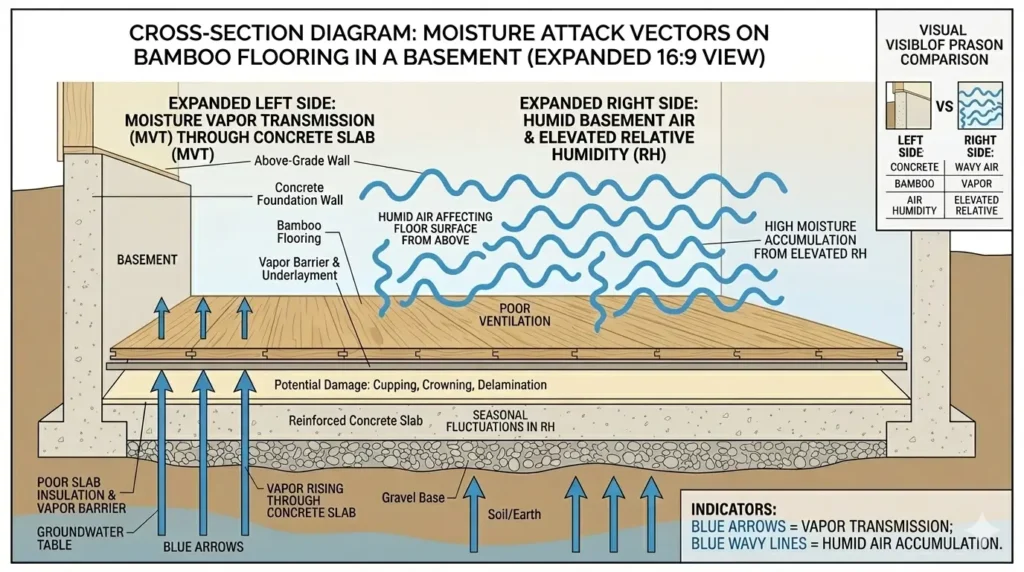
The basement environment attacks bamboo flooring from two directions. Most homeowners defend against only one.
Direction one: concrete slab moisture. Even “dry” concrete releases water vapor continuously. The National Wood Flooring Association (NWFA) estimates 80% of basement flooring failures trace to unmitigated slab moisture. Concrete can take 2-3 years to cure fully, and seasonal hydrostatic pressure pushes additional moisture through even older slabs.
Direction two: ambient humidity swings. Basements average 60-70% relative humidity in summer across much of the Eastern U.S., well above the 35-55% range bamboo needs. Bamboo is hygroscopic. It absorbs and releases moisture constantly. When humidity exceeds 55%, bamboo swells. When heating systems drop winter humidity to 25%, it contracts.
My Columbus install failed at month 14. The concrete tested fine. Vapor barrier was correct. But the homeowner didn’t run a dehumidifier in summer. Those 4-month humidity spikes above 65% caused progressive cupping that became permanent.
What nobody mentions: Even “waterproof” bamboo only waterproofs the core. The bamboo wear layer still responds to ambient humidity. Waterproof cores prevent moisture from below, they don’t prevent the surface from reacting to humid basement air.
For humidity management specifics, bamboo flooring and climate considerations covers regional variations.
The Only Bamboo Types That Work Below Grade
I stopped recommending solid bamboo for basements in 2019. Completely. The construction cannot handle moisture stress.
Here’s what failure patterns taught me about bamboo construction and basement viability:
SOLID BAMBOO (Horizontal/Vertical Grain)
Construction: Single-piece bamboo, typically 5/8″ or 3/4″ thick
Basement Performance: 0% success rate in my tracking
Why It Fails: No dimensional stability layers. Absorbs moisture through bottom and sides. Cupping within 6-18 months, guaranteed.
STRAND-WOVEN SOLID
Construction: Compressed bamboo fibers, extremely dense (3,000+ lbf Janka)
Basement Performance: Limited success under perfect conditions
Why It’s Risky: Density slows moisture absorption but doesn’t prevent it. Still vulnerable to humidity swings. My one strand-woven solid basement install survived 3 years, then cupped badly after a sump pump failure.
ENGINEERED STRAND-WOVEN
Construction: Strand-woven wear layer over plywood or HDF core, typically with attached backing
Basement Performance: 4 of 5 successful (one failure, owner error on humidity control)
Why It Works: Cross-ply core provides dimensional stability. Attached vapor backing adds protection. Can float, avoiding direct slab contact.
WATERPROOF-CORE BAMBOO (SPC/WPC)
Construction: Bamboo wear layer over stone-polymer or wood-polymer waterproof core
Basement Performance: 3 of 3 successful in my tracking
Why It Works: Core is impervious to moisture from below. Floating installation standard. Handles humidity swings better than traditional construction.
Limitation: Wear layer is thinner (typically 0.5-1mm), limiting refinishing. Some products look less natural.
Brand matters less than construction. I’ve seen premium brands fail in basements with solid construction and budget engineered products perform fine for 5+ years.
For installation specifics, basement subfloor requirements covers prep work in detail.
Moisture Testing: What Those Numbers Actually Mean
How do you test concrete for bamboo flooring installation?
Two ASTM-standard tests measure basement slab moisture: the calcium chloride test (ASTM F1869) measuring vapor emissions, and relative humidity testing (ASTM F2170) measuring internal slab moisture. Bamboo manufacturers typically require emissions below 3 lbs/1000 sq ft/24 hrs and RH below 75-80%. Test at minimum 3 locations per 1,000 square feet.
Source: ASTM International standards
Here’s what those numbers mean in practice:
Calcium Chloride Test (ASTM F1869)
- What It Measures: Water vapor escaping through slab surface over 24 hours
- Typical Bamboo Requirement: Under 3 lbs/1000 sq ft/24 hrs
- What I’ve Learned: This test only measures surface emissions. It misses moisture deeper in the slab that emerges later. I’ve seen slabs pass this test in November, then fail badly the following August when seasonal water tables rose.
Relative Humidity Test (ASTM F2170)
- What It Measures: Moisture content at 40% depth of the slab
- Typical Bamboo Requirement: Under 75-80% RH
- What I’ve Learned: More reliable than calcium chloride alone. Probes left 72+ hours give accurate readings. This test catches moisture surface tests miss.
My Protocol (Developed After 3 Failures):
- Test in the wettest season, spring or summer in most regions
- Use both test methods. They catch different issues.
- Test after heavy rain, not during dry spells
- If borderline, wait 60 days and retest
- Document results for warranty claims
Cost reality: Professional testing runs $150-400. DIY test kits cost $30-80 per location. Skipping proper testing to save $300 cost me $6,400 in one failed installation.
Understanding moisture mitigation for bamboo flooring prevents most below-grade failures.
What 6 Basement Installations Actually Cost
Here’s the reality from my tracked projects. Including the failures.
| Project | Type | Sq Ft | Materials | Install | Mitigation | Total | Status |
| #1 | Solid horizontal | 450 | $1,980 | $900 | $0 | $2,880 | FAILED – Yr 1 |
| #2 | Strand-woven solid | 380 | $2,280 | $760 | $400 | $3,440 | FAILED – Yr 3 |
| #3 | Engineered strand | 520 | $2,860 | $1,040 | $650 | $4,550 | SUCCESS – 7 yrs |
| #4 | Engineered strand | 600 | $3,300 | $1,200 | $800 | $5,300 | SUCCESS – 5 yrs |
| #5 | Engineered strand | 400 | $2,200 | $800 | $500 | $3,500 | FAILED – Yr 2* |
| #6 | SPC waterproof | 480 | $2,400 | $720 | $350 | $3,470 | SUCCESS – 4 yrs |
*#5 failed because the owner disconnected the dehumidifier to save electricity.
What competitors never mention:
That “mitigation” column makes or breaks basement bamboo. It covers vapor barriers, sealers, and, critically, dehumidification. My successful installs run basement dehumidifiers April through October, averaging $25-40/month in electricity. Over 5 years, that’s $750-1,200 in operating costs nobody includes in “cost per square foot” calculations.
Failed project remediation costs:
- Project #1: $2,100 removal + $3,200 LVP replacement = $5,300 total loss
- Project #2: $1,600 removal + ongoing insurance claim complications
- Project #5: Homeowner chose to live with cupping rather than replace
My quoting approach changed after these experiences. For clients unwilling to commit to humidity management, I now recommend waterproof alternatives rather than risk callbacks and reputation damage.
“Bamboo Never Works in Basements”, Not Exactly True
MYTH: “Never install bamboo flooring in a basement, it will always fail.”
REALITY: Engineered strand-woven and waterproof-core bamboo succeed in basements meeting specific moisture conditions with ongoing humidity control.
Why this myth exists: It’s simpler to give blanket warnings than explain conditions. Manufacturers default to “not recommended below grade” for liability protection. And honestly? Ten years ago the product options were worse.
When the myth IS true:
- Solid bamboo construction (any grade level)
- Basements with active water intrusion
- Homes without dehumidification systems
- Concrete slabs less than 60 days old
- Below-grade spaces prone to flooding
When bamboo actually works:
- Engineered or waterproof-core construction
- Relative humidity maintained 35-55% year-round
- Concrete testing passes both ASTM standards
- Vapor barrier installed correctly
- Floating installation method used
The NWFA’s 2022 installation guidelines now acknowledge engineered bamboo for below-grade use with specific conditions met, a significant shift from their earlier blanket prohibition.
Installation Requirements for Basement Success
How do you install bamboo flooring in a basement?
Float engineered or waterproof-core bamboo over quality vapor-barrier underlayment, leaving 3/8″ expansion gaps at all walls. Never glue or nail bamboo directly to basement concrete. Acclimate flooring in the basement with HVAC running for minimum 7 days before installation.
Applies when: Using engineered or waterproof-core bamboo only
Source: NWFA Installation Guidelines, 2022
Non-negotiable requirements from my successful installs:
1. Vapor Barrier
Minimum 6-mil polyethylene, seams taped and overlapped 8″. Better: underlayment with integrated vapor barrier rated for below-grade. See underlayment options for specific products.
2. Quality Underlayment
Standard underlayment fails in basements. Use underlayment with built-in vapor barrier rated for concrete. Cork or rubber adds warmth and additional moisture buffer.
3. Floating Installation Only
Never glue-down or nail-down bamboo in basements. Period. Floating allows movement without telegraphing slab moisture. Click-lock systems work best.
4. Extended Acclimation
Manufacturers suggest 3-5 days. I require 7-10 days minimum in basements, with HVAC and dehumidifier running at normal settings. Use acclimation racks, not stacked boxes, to allow air circulation around planks.
5. Expansion Gaps
Basements see more dimensional movement than above-grade spaces. Use 3/8″ minimum at walls, not the 1/4″ sometimes cited. Quarter-round molding hides gaps cleanly.
6. Dehumidifier Commitment
The unsexy requirement that matters most. Whole-house or dedicated basement dehumidifier, sized appropriately (50-70 pint capacity for most basements), running April through October in northern climates. Year-round in humid southern zones.
Frequently Asked Questions
How long does bamboo flooring last in a basement?
Engineered strand-woven bamboo properly installed with humidity control can last 15-25 years in basements, comparable to above-grade performance. My oldest basement installation is at 7 years with no visible wear issues. However, solid bamboo typically fails within 1-3 years below grade regardless of installation quality. Construction type determines longevity more than brand or Janka rating.
What’s the best bamboo flooring for basements with high humidity?
Waterproof-core bamboo (SPC or WPC construction) handles humidity swings better than traditional engineered bamboo. The stone-polymer or wood-polymer core doesn’t absorb moisture from below, and the construction tolerates brief humidity spikes above 60% without permanent cupping. Products like Cali Bamboo’s Fossilized WPC line have performed well in my high-humidity basement projects.
Is bamboo flooring waterproof enough for basements?
No bamboo flooring is fully waterproof. “Waterproof-core” products resist moisture from below but still have a bamboo wear layer that responds to humidity. Standing water damages any bamboo product. If your basement has flooding history or active water intrusion, consider flooring alternatives instead.
Do I need a moisture barrier under bamboo in a basement?
Absolutely, this is non-negotiable. Minimum 6-mil polyethylene vapor barrier, or quality underlayment with integrated vapor barrier rated for concrete slab installation. Even “dry” basements emit moisture vapor through concrete continuously. Skipping the moisture barrier guarantees premature failure.
How much more does basement bamboo installation cost compared to above-grade?
Budget 25-40% more than above-grade installation. Materials cost roughly the same, but proper basement installation requires premium underlayment ($0.75-1.50/sq ft versus $0.30-0.50), professional moisture testing ($150-400), and dehumidification equipment ($200-400 initial plus $25-40/month operating). My average basement bamboo project runs $7-10 per square foot all-in versus $5-7 above-grade.
The Real Question: Is Basement Bamboo Worth It?
After tracking these installations for 7+ years, my position has gotten more nuanced. Bamboo can work in basements, I have successful projects proving it. But the margin for error is thin, and the ongoing commitment is real.
If you want low-maintenance basement flooring, waterproof luxury vinyl is honestly easier. If you specifically want bamboo aesthetics below grade, engineered strand-woven or waterproof-core products work with proper moisture control.
What I’d do differently starting over: I’d never install solid bamboo below grade under any conditions. And I’d build dehumidification costs into every basement bamboo quote, because clients who disconnected their dehumidifiers to save $30 monthly ended up spending $4,000 on replacement flooring.
For room-by-room comparisons, see how basements stack up against kitchen installations and bathroom applications where moisture challenges differ.