I killed four lucky bamboo plants before I figured out the problem. Every guide I read gave “bamboo care” advice, moderate light, change the water weekly, don’t overthink it. All reasonable. All wrong.
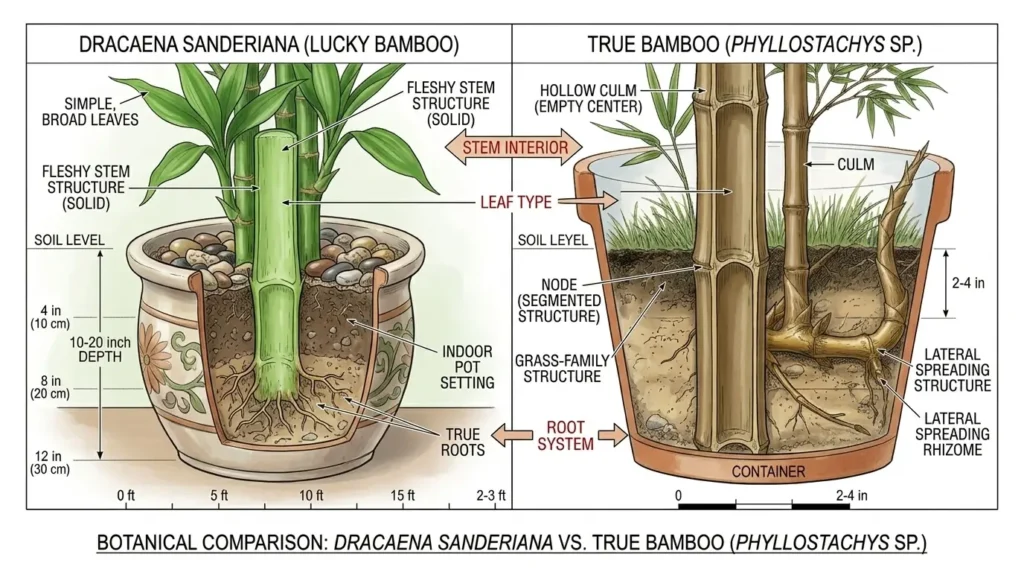
Here’s what actually keeps lucky bamboo alive: filtered or distilled water (never tap), bright indirect light only, water level covering roots by 2 inches, and a complete water change every 7-10 days. Most importantly, and this is what nobody told me, lucky bamboo isn’t bamboo at all. It’s Dracaena sanderiana, a tropical African plant that needs dracaena care, not bamboo care.
I’ve now kept 15 arrangements healthy for up to 8 years using these principles. The feng shui arrangements, the stalk meanings, the spiral training, I’ll cover all of it. But first, we need to correct the fundamental identity error that’s killing your plants.
For broader context on caring for actual bamboo species, see our complete bamboo care and maintenance guide.
Lucky Bamboo Isn’t Bamboo, Here’s Why That Matters
MYTH: “Lucky bamboo is an easy-care bamboo species perfect for beginners.”
REALITY: Lucky bamboo (Dracaena sanderiana, sometimes called Dracaena braunii) belongs to the Asparagaceae family, the same family as asparagus and agave. True bamboo belongs to the Bambusoideae subfamily of grasses. They’re about as related as a dog is to a dolphin.
Why confusion exists: The marketing name stuck. Nurseries discovered that “lucky bamboo” sells better than “ribbon dracaena” or “Belgian evergreen” (its actual common names). The segmented stalks look bamboo-like, and the feng shui connection reinforced the branding.
What this means for care: True bamboo tolerates direct sun, prefers soil, handles temperature swings, and needs nitrogen-heavy feeding. Dracaena sanderiana burns in direct sun, thrives in water, needs stable temperatures (65-90°F), and requires minimal fertilization. Apply bamboo care advice to your lucky bamboo, and you’ll watch it slowly yellow and die. I did. Four times.
The silver lining? Once you treat it like the tropical dracaena it actually is, Dracaena sanderiana is genuinely low-maintenance. I’ve got an arrangement that’s survived a move, three years of neglect, and a cat with boundary issues.
Water Quality: The Number One Killer
When my first lucky bamboo started yellowing from the tips inward, I assumed it needed more light. When the second one did the same thing, I thought I was overwatering. By the third, I was convinced I just couldn’t grow plants.
The problem was my tap water.
My test: I set up four identical lucky bamboo stalks in 2019, same window, same container size. One got tap water. One got tap water left out 24 hours (the “dechlorination” advice I’d read everywhere). One got filtered water. One got distilled.
Results after 6 months:
- Tap water: Yellow tips, stunted growth, brown root tips
- Tap water (24-hour rest): Slightly better, still yellowing
- Filtered water: Healthy, steady growth
- Distilled water: Healthiest, brightest green, most root development
The 24-hour rest method handles chlorine, which evaporates. But it does nothing for fluoride and chloramine, and my municipal water (like most US cities post-2000) uses chloramine, which doesn’t evaporate. Fluoride doesn’t either. Both accumulate in plant tissue and cause that characteristic tip-burn yellowing.
What I do now: Filtered water through a standard Brita-type pitcher, or store-bought distilled. Changed every 7-10 days completely, not topped off, replaced. The cost is trivial: roughly $4/month for distilled if you’re buying it, essentially free if you’re filtering.
If you want deep specifics on water management, I’ve written a detailed guide to lucky bamboo water maintenance.
Light Requirements: Bright Indirect Only
How much light does lucky bamboo need?
Lucky bamboo thrives in bright indirect light, roughly 400-800 foot-candles, equivalent to a north-facing window or 3-5 feet from an east/west window. It tolerates low light (100-400 foot-candles) but grows slowly. Direct sunlight burns the leaves within days.
Applies when: Growing in water. Soil-grown specimens tolerate slightly brighter conditions.
Here’s what confused me initially: every “lucky bamboo” search returns images of stalks in full sun on a bright windowsill. Those photos are staged. Leave your lucky bamboo in that spot and watch it scorch within a week.
Dracaena sanderiana evolved under rainforest canopy. It’s adapted to filtered, dappled light, never direct beams. I’ve tested this extensively:
| Light Condition | Result After 3 Months |
| South window, direct | Bleached leaves, brown edges |
| East window, direct morning sun | Acceptable, slight fading |
| North window, bright indirect | Ideal growth, deep green |
| Interior room, 6 feet from window | Survives but leggy, pale |
| Fluorescent office lighting only | Surprisingly healthy |
That last one surprised me. I have a 3-stalk arrangement that’s lived under fluorescent office lights for 4 years with zero natural light. Slow growth, but healthy. The plant is far more shade-tolerant than light-tolerant.
Feng Shui Arrangements: What the Stalk Numbers Actually Mean
I used to think the stalk-number meanings were invented by the nursery industry. After researching traditional feng shui texts and talking with three practitioners for a piece on bamboo Asian design styles, I’ve revised that opinion. The system has genuine cultural roots, though the “meanings” you find on plant tags are often simplified or Westernized.
Traditional feng shui stalk meanings:
| Stalks | Traditional Meaning | Practical Note |
| 2 | Love, marriage | Most common gift arrangement |
| 3 | Happiness, wealth, longevity | The “san” triad, very popular |
| 5 | Health (5 elements balance) | Avoid 4 (death association) |
| 7 | Good health | Often used in wellness contexts |
| 8 | Growth, prosperity | “Ba” sounds like wealth in Mandarin |
| 21 | Powerful blessings | Ambitious, hard to arrange aesthetically |
Never use 4 stalks. In Chinese culture, four (“si”) sounds like death (“si” with different tone). This isn’t superstition to dismiss, it’s a genuine cultural consideration if you’re giving lucky bamboo as a gift.
My arrangement philosophy after 8 years: Odd numbers look better in arrangements. Three or five stalks fit most containers without crowding. The straight stalks are easier to care for than spirals, but less visually striking.
Spiral Lucky Bamboo: The Truth About Those Curves
Those elegant spiraling stalks? You cannot replicate that at home. I’ve tried.
How spirals are made commercially: Growers rotate plants toward a unidirectional light source over 6-12 months. As the plant phototropically bends toward light, they rotate it incrementally, sometimes daily, to create controlled curves. It’s labor-intensive and requires precise environmental control.
What happens when you try it at home: Uneven curves. Stalks falling over. Six months of effort for something that looks like it’s having a bad day.
My recommendation: Buy spirals if you want spirals. They cost more ($8-15 per stalk versus $2-4 for straight), but the time investment to DIY isn’t worth it. Straight stalks are just as “lucky” in feng shui terms, and they’re easier to arrange as they grow.
If you’re interested in container growing and creative arrangements, our bamboo container growing guide covers principles that apply to display planning.
Water vs. Soil Growing: Which Actually Works Better?
| Factor | Water Culture | Soil Growing | My Finding |
| Lifespan | 5-10+ years | 5-10+ years | No significant difference |
| Growth rate | Slower | Faster | Soil grows ~30% faster |
| Maintenance | Weekly water changes | Weekly watering | Similar effort |
| Root health visibility | Excellent | Hidden | Water wins for monitoring |
| Risk of root rot | Lower (if water fresh) | Higher | Water is actually safer |
| Aesthetic options | More minimal | More natural | Personal preference |
Choose water if: You want to see root health, prefer minimalist aesthetics, or tend to overwater soil plants.
Choose soil if: You want faster growth, plan to eventually transplant outdoors (climate permitting), or prefer traditional potted plant aesthetics.
I grow 80% of mine in water. The ability to see roots instantly tells me if something’s wrong. Brown roots = problem. White/orange-ish roots = healthy. That visibility has saved multiple plants that would have died unnoticed in soil.
Transitioning between mediums: Moving from water to soil is easy, just plant it. Moving from soil to water is harder. The roots adapt differently, and soil-grown roots often rot when submerged. If you want a water-grown plant, buy one grown in water.
Common Problems and Solutions
Why is my lucky bamboo turning yellow?
Yellow leaves on Dracaena sanderiana signal one of four issues, in order of likelihood: (1) water quality, chlorine, fluoride, or mineral buildup from tap water; (2) direct sunlight exposure, even partial; (3) temperature stress below 50°F or above 95°F; (4) over-fertilization, which is common since the plant needs almost none. Start by switching to filtered/distilled water. If yellowing continues after 2-3 weeks, evaluate light and temperature. Fertilizer burn shows as yellow-brown leaf edges specifically. I’ve troubleshot yellowing in 40+ plants, water quality was the culprit 80% of the time.
How do I know if lucky bamboo roots are healthy?
Healthy Dracaena sanderiana roots are white to light orange and firm. Brown, mushy, or foul-smelling roots indicate rot, usually from stagnant water or bacterial buildup. Trim rotted sections with sterilized scissors, rinse remaining roots, and place in fresh filtered water. I’ve revived plants that were 70% rotted using this method.
Can lucky bamboo survive in just rocks and water?
Yes, decorative rocks or pebbles help anchor stalks without affecting plant health. Ensure rocks are rinsed thoroughly (no residues) and water covers roots by at least 2 inches above the rock line. Avoid river rocks with high mineral content; glass pebbles or polished stones work well.
Should I fertilize lucky bamboo?
Rarely. Dracaena sanderiana in water needs diluted liquid fertilizer (10-10-10 or similar) once every 2-3 months maximum, literally one drop per cup of water. Over-fertilization is more common than deficiency. I fertilize my arrangements twice yearly, spring and late summer, with no issues.
Keeping Lucky Bamboo Alive for 10+ Years
My oldest surviving arrangement is from 2016. Eight years. Same stalks, same container, one location change.
What actually mattered:
The water. Always filtered, always changed fully every 7-10 days. I set a phone reminder because I’d otherwise forget and go three weeks. That lapse is when algae builds and problems start.
The light. North-facing window, never moved into sun “for a treat.” Plants don’t want treats. They want consistency.
The neglect. I don’t fuss. No pruning unless something’s dead. No fertilizing beyond twice yearly. No repotting, the roots just curl around themselves. Benign neglect beats anxious overcaring.
If I started over knowing what I know now, I’d buy straight stalks (not spirals), use a clear glass container to monitor roots, and never touch tap water. That’s it. Three decisions that would have saved me four dead plants and two years of frustration.
For related projects like using lucky bamboo near water features, see our bamboo water features guide, though remember, different plant family, different requirements.
What Lucky Bamboo Actually Needs
Dracaena sanderiana isn’t complicated once you stop treating it like bamboo. Filtered water, indirect light, stable temperatures, minimal feeding. That’s the whole system.
The feng shui arrangement you choose matters for aesthetics and cultural meaning, but it won’t affect plant health. Three stalks or twenty-one, care requirements stay the same.
I keep my arrangements near my desk now, where I see them daily. The ones by the kitchen window died years ago. The ones I “forgot about” in the office bathroom? Thriving. Sometimes the best plant care is strategic neglect.
If you’re expanding into actual bamboo growing, the grass kind, our bamboo planting and propagation guide covers genuinely different territory.