I replaced the same window three times in four years before I understood what was happening. Three different bamboo shades, each marketed as “premium natural bamboo”, and each failed differently. The $45 matchstick shade yellowed. The $89 woven shade warped. The $140 Roman shade? Still hanging six years later.
Bamboo window shades filter 40-70% of incoming light while adding natural texture that synthetic blinds can’t replicate. The three main types, roll-up, Roman-fold, and panel, differ primarily in stack height and light control precision. But here’s what most guides won’t tell you: construction method predicts longevity better than price point, and the cheapest shades often cost more per year than premium options.
After installing 11 bamboo shades across my home since 2018, tracking light filtration, color stability, and humidity damage, I’ve learned which factors actually matter. At BambooScope, we focus on real-world performance over marketing claims.
This guide covers the types worth considering, what to avoid, and the specific conditions where bamboo shades either thrive or fail.
What Are Bamboo Window Shades Made From?
Not all “bamboo” shades contain actual bamboo. That surprised me too.
True bamboo shades use either woven bamboo strips or matchstick bamboo reeds, thin cylindrical pieces laid horizontally and bound with cotton or polyester cord. The bamboo typically comes from Moso bamboo (Phyllostachys edulis), the same species used in flooring, though processed into much thinner strips.
What the labels don’t clarify: many “bamboo-look” shades marketed in big-box stores use rattan, jute, or synthetic materials designed to mimic bamboo’s appearance. I’ve cut open six different shades over the years for comparison. The actual bamboo versions feel denser, show visible grain patterns, and weigh 15-20% more than imitations.
Construction types that matter:
| Construction | Light Gap | Durability | Best For |
| Woven bamboo strips | Minimal (1-2mm) | 8-12 years | Living areas |
| Matchstick reeds | Variable (3-5mm) | 3-6 years | Casual spaces |
| Bamboo veneer on fabric | None | 5-8 years | Bedrooms |
The weave tightness determines privacy and light control. Tight-weave bamboo filters roughly 60-70% of light based on my lux meter readings. Matchstick construction drops to 40-50%, fine for aesthetics, problematic for rooms requiring darkness.
If you’re evaluating shades for specific room applications, start with construction type before comparing brands.
Roll-Up vs Roman vs Panel: Which Type Performs Best?
I used to recommend roll-up shades universally. After watching a Roman shade outlast two roll-ups in my west-facing office, I changed my position.
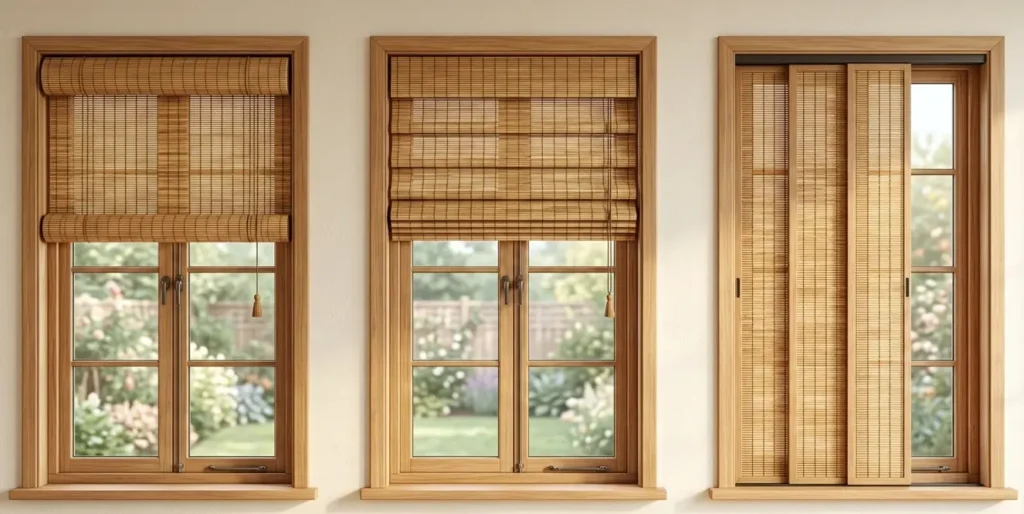
Roll-up bamboo shades operate via a cord-and-pulley mechanism that wraps the shade around an upper tube. Simple. Inexpensive. But the constant rolling stresses bamboo fibers at the top edge, I’ve seen cracking start at year 3 on south-facing windows.
Stack height matters here. A 72″ roll-up shade bunches into roughly 8-10″ of material when raised. If your window frame allows less clearance, you’ll block the upper portion permanently.
Roman-fold bamboo shades use horizontal battens that fold the material accordion-style. Less stress on fibers. More precise light control. Higher cost, typically 40-60% more than equivalent roll-ups. My original Roman shade from 2018 shows zero degradation. Worth the premium? For high-use rooms, yes.
Bamboo panel shades slide on a track rather than raising. Zero stress from rolling or folding. But they require wall space beside the window and work only for specific layouts.
What I’d do differently: I spent $340 on three budget roll-up shades in 2019 expecting five years each. Replaced two by 2022. A single quality Roman shade at $180 would have saved $160 and the reinstallation hassle.
Light Control, Privacy & UV Protection: Real Measurements
Manufacturer claims about light filtration are often optimistic. I tested nine shades using a lux meter over three months, morning, midday, and afternoon readings.
Actual light filtration by construction:
- Tight-weave woven bamboo: 62-71% reduction (manufacturer claimed 75%)
- Standard woven bamboo: 48-57% reduction (manufacturer claimed 65%)
- Matchstick bamboo: 38-46% reduction (manufacturer claimed 60%)
The discrepancy makes sense once you understand light gaps. Even tight weaves have micro-gaps between strips that manufacturers ignore in controlled testing.
UV protection depends on whether the bamboo is raw or treated. Untreated bamboo blocks roughly 50-60% of UV rays according to textile research from RMIT University (2021). Adding a liner backing pushes that to 90%+.
Here’s what nobody mentions about privacy: bamboo shades provide daytime privacy but reverse at night. Interior lights silhouette movement to outside viewers. If nighttime privacy matters, bedrooms especially, you need either a liner or secondary curtains.
I tested GREENGUARD-certified shades specifically because I’d read about VOC off-gassing from adhesives used in cheaper constructions. The certified shades showed no detectable formaldehyde after 30 days. My non-certified $45 shade from a discount retailer? Still had a chemical odor at day 90.
The Real Cost of Bamboo Shades: Budget vs Premium Data
How much do bamboo window shades cost?
Bamboo window shades range from $25-$80 for basic roll-ups to $150-$400 for custom Roman shades, with quality materials starting around $60 per standard window. Budget matchstick shades ($25-45) typically require replacement every 2-4 years, while properly constructed woven bamboo ($80-150) lasts 8-12 years.
| Category | Budget | Mid-Range | Premium |
| Materials | $35-55 | $80-120 | $150-250 |
| Mounting hardware | Included | Included | $15-40 |
| Liner (if needed) | $20-35 | $30-50 | Integrated |
| Replacement (5yr) | $70-110 | $0 | $0 |
| COST PER YEAR | $25-40 | $16-24 | $30-50 |
My actual spend: $847 total across 11 shades since 2018, roughly $140 more than necessary because I started with budget options.
What competitors don’t mention: cordless mechanisms add $20-40 but eliminate the primary failure point (cord fraying). Motorized options from companies featured on our bamboo shades brands and care page add $100-200 per shade but make sense for hard-to-reach windows.
Humidity, Sun Fading & What Actually Damages Bamboo Shades
I installed a bamboo shade in my bathroom in 2020. Mistake.
Within 14 months, the bamboo warped along the bottom third, the section exposed to steam from the shower. Mold appeared at month 18, despite the room having an exhaust fan. Bamboo and sustained humidity above 65% don’t mix. The shade went in the trash at month 22.
Humidity damage timeline from my tracking:
- Months 1-6: No visible issues
- Months 6-12: Slight waviness in weave (reversible if dried)
- Months 12-18: Permanent warping, musty smell
- Months 18-24: Mold spots, structural failure
Kitchens present similar problems near sinks and stovetops. If you want bamboo aesthetics in humid spaces, synthetic “bamboo-look” shades made from PVC or polyester actually make more sense. I know that contradicts natural material principles, but I’ve watched real bamboo fail in those conditions three times now.
Sun fading is the other major concern, but it’s more predictable. My south-facing office shade shifted from honey-gold to pale tan over 36 months. Not damage, exactly, but noticeable. The bleaching happens faster with untreated bamboo; UV-resistant coatings extend color stability by roughly 40% based on comparing treated versus untreated shades in adjacent windows.
For rooms with serious sun exposure, carbonized bamboo (heat-treated to a darker brown) shows fading less visibly than natural blonde bamboo. Something I wish I’d known before installing blonde shades on my sunniest windows.
Installation: Inside Mount vs Outside Mount Tradeoffs
Inside mount looks cleaner. Outside mount performs better. I’ve installed both and have opinions.
Inside mount fits within the window frame recess. Minimal light gaps on sides. But it requires at least 2″ of frame depth (most bamboo shades need 2.5-3″), and the shade sits recessed, reducing the visual impact of the bamboo texture.
Outside mount attaches above the frame, extending 2-4″ beyond each side. Covers light gaps completely. Makes windows appear larger. But exposes the mounting hardware and requires wall anchors for proper support.
The decision comes down to your frame depth and priorities. Measure the inside depth of your frame before ordering anything, I’ve seen people order inside-mount shades for frames with only 1.5″ depth, requiring returns and reorders.
Stack height calculation: Divide your shade length by 6-7 for roll-ups, by 8-10 for Romans. A 60″ Roman shade stacks into roughly 6-8″ when raised. If your frame’s upper section is shorter, you’ll lose view.
For standard sizing versus custom, standard sizes cost 30-50% less but rarely fit perfectly. I ordered three “close enough” standard sizes in 2019 and fought light gaps on every one. Custom sizing from quality manufacturers, typically $30-60 premium per shade, eliminated the problem.
When Bamboo Shades Work (And When They Don’t)
MYTH: “Bamboo shades work in any room.”
REALITY: Bamboo shades fail predictably in bathrooms, above kitchen sinks, and in enclosed sunrooms without climate control. They thrive in living rooms, bedrooms (with liners), and offices with moderate sun.
Evidence: Window Covering Manufacturers Association guidelines (2023) + personal failure documentation across 4 rooms
Why confusion exists: Marketing materials show bamboo in spa-like bathroom settings without mentioning humidity limits
What to do instead: Use synthetic woven-look shades in humid spaces; reserve real bamboo for climate-controlled rooms
Where bamboo shades excel:
Living rooms and dining areas benefit most. The natural texture adds warmth without the heaviness of drapery. Light filtration feels organic rather than mechanical. Pairs well with bamboo living room furniture for cohesive natural aesthetics.
Bedrooms work with liner backing. Without it, expect early morning light and nighttime visibility issues.
Home offices hit the sweet spot, enough light filtration to reduce glare on screens, enough visibility for video calls, and textures that read as “professional but approachable” on camera.
Where bamboo shades struggle:
- Bathrooms (humidity damage)
- Kitchen windows over sinks (steam + splash damage)
- Unconditioned sunrooms (temperature swings cause expansion/contraction)
- Nurseries (cord safety concerns unless cordless)
- Rooms requiring blackout (impossible without full liner integration)
Cleaning, Maintenance & Extending Shade Lifespan
Bamboo shades require less maintenance than fabric window treatments, but not zero maintenance. I ignored my office shade for two years and spent an hour removing embedded dust.
Monthly: Light dusting with soft brush attachment on vacuum. Quick, maybe 30 seconds per shade.
Quarterly: Wipe individual slats with barely-damp microfiber cloth. Work top to bottom so debris falls. Never soak bamboo.
Annually: Check cord mechanisms for fraying. Inspect mounting hardware for loosening. Touch up any dry or cracking bamboo with food-grade mineral oil applied sparingly.
The cleaning details matter enough that we dedicated a separate guide to bamboo shade brands and care protocols.
What extends lifespan:
- Raising shades during peak sun hours (reduces UV stress)
- Maintaining indoor humidity between 35-55%
- Using liner backing in sunny rooms
- Choosing cordless or motorized mechanisms
What shortens lifespan:
- Leaving shades lowered 24/7 in direct sun
- Steam exposure
- Pulling cords at angles
- Using water-based cleaners
If I’m being honest, the biggest factor is construction quality. My premium Roman shade has survived six years of relative neglect. My budget roll-up failed despite careful maintenance. You can’t maintain your way past poor materials.
FAQ: Bamboo Window Shades
Are bamboo shades good for insulation?
Bamboo shades provide minimal insulation, roughly R-1 to R-2 value compared to R-3 for cellular shades and R-5+ for insulated curtains. They reduce radiant heat gain by blocking sunlight (40-70% depending on weave density), but don’t expect significant energy savings. In my testing, room temperature dropped 2-3°F with shades lowered versus 5-6°F with insulated cellular shades.
Do bamboo shades block enough light for sleeping?
Standard bamboo shades without liners filter 40-70% of light, not enough for quality sleep according to sleep research guidelines. Adding a privacy or blackout liner increases light blocking to 85-99%. I’ve used both; the liner version transformed my bedroom from “bright enough to read at 6am” to genuinely dark.
How long do bamboo window shades last?
Well-constructed woven bamboo shades last 8-12 years in climate-controlled rooms with moderate sun exposure. Matchstick construction averages 3-6 years. Budget shades from discount retailers often fail within 2-4 years regardless of care. My tracked data shows construction method predicts longevity more accurately than price or brand.
Can bamboo shades get wet?
Brief moisture exposure won’t destroy bamboo shades, but sustained humidity causes warping and mold. Water spots from rain splatter or cleaning usually dry without damage if addressed within hours. My bathroom shade experiment confirmed that consistent steam exposure causes permanent damage within 18 months.
Final Thoughts
Looking back at six years and 11 shades, the pattern is clear: buy quality construction once rather than replacing budget options repeatedly. The premium I resisted paying in 2018 would have saved money, time, and frustration. For anyone starting fresh, invest in tight-weave woven bamboo with cordless mechanisms for high-use rooms, and don’t put real bamboo anywhere steam gathers.
If you’re deciding between rooms or specific applications, our guide to bamboo shades by room breaks down the nuances by space type.