Most bamboo sheets are bamboo viscose or bamboo rayon, meaning bamboo pulp dissolved in chemicals and extruded into fiber. True bamboo fabric (mechanically processed bamboo linen) represents less than 5% of the market and costs 3-4x more. The good news? Bamboo-derived rayon can still outperform cotton for temperature regulation and softness, you just need to understand what you’re actually buying.
I’ve now tested six bamboo sheet sets across four years, tracking everything from summer night temperatures to wash-cycle durability. What follows is what I wish I’d known before that first purchase, including why thread count is meaningless for bamboo and which processing method actually matters for your sleep. If you’re building out a bamboo bedroom setup, sheets are where most people start, and where the most confusion exists.
What Are Bamboo Sheets Actually Made Of?
The term “bamboo sheets” covers three completely different fabrics with different properties, price points, and environmental footprints. Understanding this distinction is the single most important factor in choosing the right sheets.
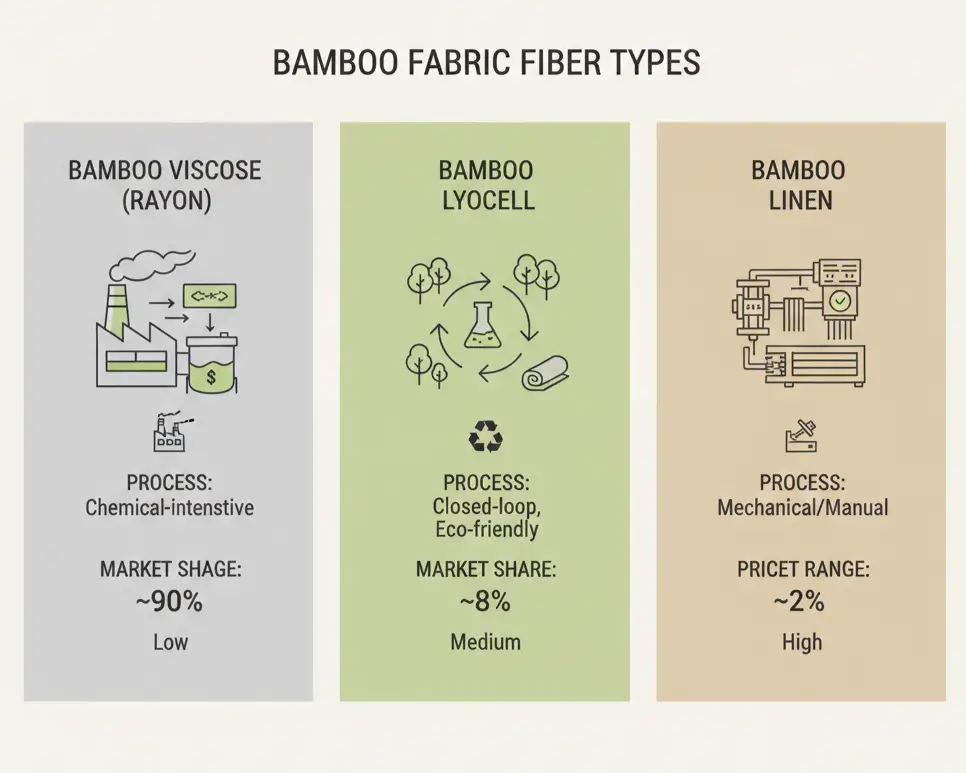
Bamboo Viscose/Rayon (95% of market): Bamboo pulp, typically from Moso bamboo (Phyllostachys edulis), is dissolved in sodium hydroxide and carbon disulfide, then extruded through spinnerets into fiber. The result is soft, breathable, and genuinely derived from bamboo, but the chemical process means the FTC requires labeling as “rayon from bamboo,” not “bamboo.” Many retailers ignore this rule. Expect to pay $40-150 per set.
Bamboo Lyocell (4% of market): Same starting material, different chemistry. Lyocell processing uses a closed-loop solvent system (typically NMMO) that recovers 99%+ of chemicals. Brands like Ettitude use this process. The fabric feels slightly crisper than viscose, holds up better to washing, and carries stronger environmental credentials. Price: $150-280 per set.
Bamboo Linen (under 1% of market): Mechanically processed from bamboo bast fibers without chemical dissolution. This is the only fabric that could legitimately be called “bamboo” without qualification. It’s textured like traditional linen, not silky. Rare and expensive: $300+ per set.
The FTC has issued multiple warnings and fines totaling over $1.5 million to retailers mislabeling rayon as “bamboo.” If a product says “100% bamboo” without mentioning rayon or viscose, that’s a red flag about the company’s accuracy elsewhere.
Do Bamboo Sheets Actually Sleep Cooler? My Temperature Data
This is the claim that sells bamboo sheets, and it’s partially true, with major caveats.
I ran a simple test: infrared thermometer readings of sheet surface temperature at 2 AM across 20 summer nights, alternating between my bamboo viscose set (Luxome, 300 thread count) and cotton sateen (400 thread count). Room temperature held at 72°F via AC.
Results:
| Metric | Bamboo Viscose | Cotton Sateen |
| Surface temp (avg) | 78.2°F | 80.1°F |
| Surface temp (range) | 76-81°F | 78-83°F |
| Perceived coolness | Noticeable | Neutral |
The 2-degree difference sounds small, but it was perceptible, I consistently rated the bamboo nights as “comfortable” vs. “slightly warm” for cotton. However, bamboo percale (crisp weave) from a different brand tested nearly identical to cotton. The cooling effect comes from fabric weight and weave as much as fiber content.
My hottest-sleeping bamboo set was a 400 GSM (grams per square meter) sateen, heavier weight trapped more heat despite the fiber type. My coolest was a 250 GSM twill weave. Fiber matters less than construction.
What no guide mentions: bamboo viscose absorbs moisture faster than cotton (good for night sweats) but also releases it slower. In humid climates without AC, this can make sheets feel clammy by morning. I experienced this in a North Carolina August when our AC failed.
Thread Count Is Meaningless, Here’s What to Measure Instead
I used to buy sheets by thread count. Then I bought a 1,000-thread-count “bamboo” set that felt like plastic wrap and pilled within six washes.
Thread count measures threads per square inch of fabric. For cotton, it’s a reasonable quality proxy (up to about 400-600 TC). For bamboo viscose, it’s marketing fiction. Here’s why:
Bamboo fibers are longer and finer than cotton. Manufacturers can split fibers artificially to inflate thread count without improving quality. A 300 TC bamboo sheet often uses thicker, more durable individual threads than a 500 TC version with split fibers.
What actually matters:
GSM (grams per square meter): This measures fabric density.
- 250-300 GSM: Lightweight, maximum breathability, less durability
- 300-400 GSM: Mid-weight, balanced performance, my preference
- 400+ GSM: Heavy, warmer, luxury hotel feel
Weave type:
- Sateen (4-over-1-under): Silky, drapes well, shows wear faster
- Twill (diagonal pattern): Balanced softness and durability
- Percale (1-over-1-under): Crisp, coolest, most durable
After testing multiple weights, I’ve settled on 300-350 GSM twill as my baseline recommendation. Sateen at any weight pilled faster for me, though different brands vary significantly.
The Durability Reality: 4 Years, 6 Sheet Sets
Here’s what I’ve learned about longevity, and why the cheapest sheets aren’t actually cheapest.
Test conditions: All sets washed weekly on gentle/cold, tumble dried low, no fabric softener (degrades bamboo fibers).
| Brand/Type | Purchase Price | Condition at Year 2 | Condition at Year 4 | Cost Per Year |
| Amazon basics viscose | $45 | Significant pilling | Replaced year 2.5 | $18 |
| Mid-range viscose (Cozy Earth dupe) | $89 | Light pilling | Moderate pilling, still usable | $22 |
| Luxome viscose | $159 | Minimal pilling | Light pilling | $40 |
| Ettitude lyocell | $199 | No pilling | Minimal softening | $50 |
| Cariloha viscose | $179 | Light pilling | Moderate wear at seams | $45 |
| Budget lyocell | $129 | Light pilling | Moderate pilling | $32 |
The pattern: Lyocell consistently outlasts viscose regardless of brand tier. But the mid-range viscose at $89 delivered the best cost-per-year value if you’re comfortable replacing at year 4.
My most expensive mistake was assuming price guaranteed quality. The $179 Cariloha set developed seam wear faster than the $89 set, potentially a construction issue rather than fabric quality. Stitching density and elastic quality matter as much as the fabric itself.
For detailed care instructions that extend lifespan, see our bamboo sheets care guide.
MYTH: “Bamboo Sheets Are Naturally Antibacterial”
REALITY: Bamboo the plant contains antimicrobial compounds. Bamboo viscose sheets do not.
This myth persists because raw bamboo contains “bamboo kun,” a natural antimicrobial agent. But the viscose process dissolves bamboo into a chemical solution and reconstitutes it as pure cellulose fiber, bamboo kun doesn’t survive.
A 2020 study published in the Journal of Fiber Bioengineering and Informatics tested bacterial growth on bamboo viscose vs. cotton. No significant antimicrobial difference was found. OEKO-TEX certification, which tests for harmful substances, does not test for or certify antimicrobial properties.
Why the confusion exists: Some brands add antimicrobial treatments post-manufacturing, then market this as “bamboo’s natural properties.” Read labels carefully. If antimicrobial benefits matter to you, look for explicit treatment claims (silver ion, etc.), not vague bamboo references.
Wash sheets weekly in hot water if bacteria is a concern. No fabric, bamboo or otherwise, stays antimicrobial through use without washing.
Sustainability Claims: Complicated, Not Clear-Cut
I initially chose bamboo because I wanted eco-friendly bedding. The reality is more nuanced than marketing suggests.
What’s genuinely better:
- Moso bamboo grows rapidly (up to 35 inches/day) without pesticides or irrigation
- Bamboo sequesters more carbon per hectare than most tree species
- No replanting required, bamboo regenerates from existing root systems
What’s problematic:
- Viscose processing uses toxic chemicals (carbon disulfide is a neurotoxin)
- Workers in poorly regulated factories face health risks
- “Closed-loop” lyocell processing recovers chemicals but requires more energy
- Most bamboo for textiles ships from China, adding transport emissions
Bamboo lyocell with OEKO-TEX Standard 100 certification represents the best compromise I’ve found. The certification ensures final products are free from harmful substances. FSC certification on bamboo sourcing adds supply chain accountability, though it’s rare in bedding.
If sustainability is your primary driver, organic cotton percale or linen may have a smaller overall footprint depending on sourcing. Bamboo’s advantage is comfort-to-sustainability ratio, not pure environmental performance.
For broader context on bamboo sustainability in home products, BambooScope’s sustainability overview covers certifications across categories.
Choosing Bamboo Sheets: Decision Framework
After four years, here’s my simplified recommendation matrix:
Choose bamboo viscose (300-350 GSM, twill weave) if:
- Budget is $80-120
- You want silky softness
- You’ll replace sheets every 3-4 years
- You sleep hot but have climate control
Choose bamboo lyocell if:
- Budget is $180+
- Durability matters more than initial cost
- Environmental processing is a priority
- You want 5+ year lifespan
Choose bamboo linen if:
- You prefer linen texture over silky feel
- Budget is $300+
- You want true mechanical bamboo fiber
- You prioritize natural processing
Skip bamboo sheets if:
- You need antimicrobial guarantees (look at copper-infused or treated fabrics)
- You want crisp, cool percale feel (cotton percale may serve better)
- Humid climate without AC (bamboo holds moisture)
Pairing bamboo sheets with bamboo pillows and bamboo blankets creates a consistent sleep surface, though mixing materials works fine if individual pieces suit your needs better.
Frequently Asked Questions
Are bamboo sheets worth it compared to cotton?
For hot sleepers with climate control, yes. My testing showed a consistent 1-2°F cooler surface temperature with bamboo viscose vs. cotton sateen at similar weights. At the $80-120 price point, bamboo offers comparable durability to cotton percale. Above $200, Egyptian cotton may compete more favorably on longevity.
How often should bamboo sheets be replaced?
Budget viscose ($40-60): 2-3 years. Mid-range viscose ($80-150): 3-4 years. Lyocell ($150+): 5-7 years with proper care. Visible pilling, thinning fabric, or elastic failure are replacement signals, not a fixed timeline.
Why do my bamboo sheets feel hot sometimes?
Likely a weight issue, not fiber. Sheets over 400 GSM trap heat regardless of fiber content. Sateen weave also insulates more than twill or percale. In humid conditions, bamboo’s moisture retention can create a clammy feel, ensure good airflow or AC.
Can I use fabric softener on bamboo sheets?
I’d avoid it. Fabric softener coats fibers, reducing breathability and moisture-wicking, the main benefits of bamboo. It also accelerates pilling. White vinegar in the rinse cycle softens without coating. Full care details in our bamboo sheets care guide.
What I’d Tell Someone Starting Fresh
Knowing what I know now, I’d buy one mid-range bamboo viscose set ($80-100, 300 GSM twill, OEKO-TEX certified) and one lyocell set ($180-220) to rotate. The viscose gives me that silky-soft feel I wanted; the lyocell provides durability for higher-use periods.
I wouldn’t chase thread count, “100% bamboo” claims, or antimicrobial marketing. I’d verify FTC-compliant labeling (“rayon from bamboo” or “viscose from bamboo”), check GSM weight if listed, and prioritize weave type for my sleep temperature preference.
The “bamboo” in bamboo sheets is real, it’s the starting material. But understanding the transformation it undergoes, and choosing based on processing method rather than plant origin, makes the difference between a marketing purchase and an informed one.