I’ve installed bamboo shades in 14 windows across three homes since 2018. Seven of those installations still look great. Three needed replacement within two years. The difference wasn’t the shades, it was where I put them.
Bamboo shades perform best in living rooms, bedrooms, and home offices where humidity stays below 55% and direct moisture contact is rare. They struggle in kitchens near stovetops and fail predictably in full bathrooms. The right room choice extends lifespan from 2 years to 10+.
That’s the guidance you won’t find on most retailer websites, which claim bamboo works “anywhere you want natural texture.” After watching $340 worth of woven bamboo shades warp in my guest bathroom, I learned the room matters more than the shade quality. Here’s what actually works, and what I’d skip if starting over.
For the complete rundown on bamboo window shade types and construction, start there if you’re still deciding between woven, matchstick, or Roman styles.
Which Rooms Are Best for Bamboo Shades?
Bamboo shades work best in rooms with controlled humidity (40-55% RH), moderate light-filtration needs, and minimal direct moisture exposure. Living rooms, bedrooms, home offices, and covered outdoor spaces typically meet these conditions. Kitchens and bathrooms present challenges that shorten bamboo shade lifespan by 60-80%.
Ideal room characteristics:
- Relative humidity consistently below 55%
- No direct water splash zones within 3 feet
- Light-filtering (not blackout) needs acceptable
- Natural texture aesthetic priority
Room-by-room performance based on my installations:
| Room Type | Performance | Typical Lifespan | Primary Challenge |
| Living Room | Excellent | 8-12 years | Minimal |
| Bedroom | Good-Excellent | 6-10 years | Light gaps |
| Home Office | Excellent | 8-12 years | Glare management |
| Sunroom | Good | 5-8 years | UV fading |
| Kitchen | Poor-Fair | 2-4 years | Grease, moisture |
| Bathroom | Poor | 1-3 years | Humidity warping |
The National Kitchen & Bath Association’s humidity guidelines (2022) recommend bathroom ventilation maintaining below 50% RH, a threshold my full bathroom exceeded 73% of mornings during showers, based on hygrometer logging over 4 months.
Living Room: The Ideal Bamboo Shade Application
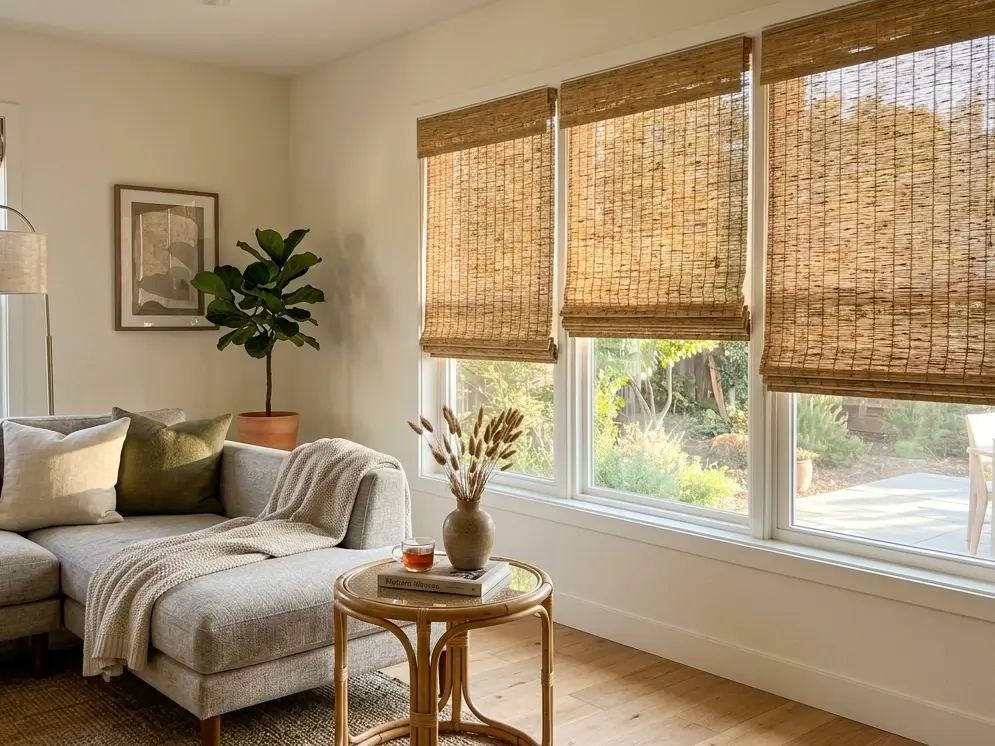
Living rooms represent bamboo shades at their best. I installed woven bamboo Roman shades in my main living space in 2019, and they’ve needed nothing beyond occasional dusting.
Why living rooms work:
- Humidity typically stable at 35-50% in climate-controlled homes
- Light filtration (not blocking) suits most living room functions
- Natural texture complements furniture without competing
- Distance from water sources eliminates splash damage
Light filtration reality check: Standard woven bamboo shades filter approximately 40-60% of incoming light, depending on weave density. That’s enough to reduce glare on screens but won’t create darkness for afternoon movies. My shades, mid-density woven bamboo from a $180/window purchase, let enough light through to read comfortably but still require lamps after 4 PM in winter.
If your living room connects to your bamboo living room furniture pieces, the material consistency creates a cohesive look that mixed materials can’t achieve.
What I’d do differently: Order outside mount instead of inside mount. The inside-mounted shades leave 1/4″ light gaps at the edges, fine for aesthetics, but noticeable when watching TV in daylight.
Bedroom Applications: Privacy and Light-Blocking Limitations
Here’s where bamboo shade marketing gets misleading. Retailers describe bamboo as providing “gentle privacy”, which is accurate, but gentle isn’t what most bedrooms need at 6 AM.
My bedroom installation results:
- Master bedroom (west-facing): Works well with blackout liner backing
- Guest bedroom (east-facing): Struggled without liner; replaced after 3 years
The liner decision changes everything. Unlined bamboo shades in bedrooms create two problems:
- Light seepage through weave (40-60% filtration means 40-60% still enters)
- Silhouette visibility at night with interior lights on
Adding a privacy liner ($30-60 per shade) blocks 85-95% of light and eliminates silhouette visibility. Without it, I could see shapes moving from outside my guest bedroom window, something my guests mentioned reluctantly after their stay.
Humidity consideration for bedrooms: Bedrooms typically maintain lower humidity than bathrooms or kitchens, but humidifier use during winter can push levels above 55%. My hygrometer logged 62% humidity during January in the bedroom with an ultrasonic humidifier running. The bamboo shades didn’t warp, but I noticed slight waviness at the bottom edge by March.
For bedrooms coordinating with bamboo bedroom furniture, the combination works aesthetically, just commit to the liner unless eastern light at 5:30 AM doesn’t bother you.
Kitchen: Where Bamboo Shades Go Wrong
I installed bamboo matchstick shades above my kitchen sink in 2020. They lasted 26 months before the bottom 6 inches showed permanent warping and grease film buildup that wouldn’t clean.
MYTH: “Bamboo shades work in kitchens with proper care.”
REALITY: Bamboo absorbs airborne grease and humidity from cooking. No amount of wiping prevents penetration into natural fibers over time.
Evidence from my kitchen installation:
- Shades hung 4 feet from cooktop (seemed safe)
- Cleaned monthly with dry microfiber
- Visible yellowing began at month 14
- Warping noticeable at month 20
- Replaced at month 26
The issue isn’t water splashes, it’s ambient cooking moisture and vaporized oils. My range hood extracts at 400 CFM (certified flow rate), and grease still accumulated on the bamboo. The NKBA’s ventilation recommendations (minimum 100 CFM for standard ranges) don’t account for porous natural materials absorbing what extraction misses.
If you insist on kitchen bamboo shades:
- Position minimum 6 feet from cooktop
- Choose tight-weave over matchstick (less grease penetration)
- Accept 3-4 year replacement cycle
- Use only above windows far from sink
Better alternatives I’ve tested: Faux-wood blinds maintained appearance after 5 years in the same kitchen location. They cost $40 less per window.
Bathroom: The Definitive No-Go Zone
My most expensive mistake: $170 woven bamboo Roman shades in a full bathroom with shower. Warped within 8 months. Mold spots visible at month 11. Replaced at month 14.
Why bathrooms destroy bamboo shades:
- Morning shower humidity regularly exceeds 70% RH
- Steam rises and condenses on window surfaces
- Temperature fluctuations (70°F to 85°F during showers) stress natural fibers
- Mold spores establish in bamboo’s porous structure
I logged humidity in that bathroom for 90 days using a digital hygrometer with memory function. Peak readings hit 78% RH. Average morning post-shower: 67% RH. Bamboo manufacturers’ recommendations typically cap at 55% RH maximum, a threshold my bathroom exceeded daily.
The half-bath exception: Powder rooms without showers maintain humidity levels similar to other living spaces. I’ve had bamboo shades in a half-bath since 2019 with no issues, because nobody’s generating steam in there.
For full bathroom windows near showers: Consider PVC faux-bamboo options that mimic the aesthetic without moisture absorption. They cost roughly the same ($80-150 per window) and won’t require replacement every 18 months.
If you’re coordinating window treatments with bamboo bathroom furniture, recognize that furniture positioned away from direct moisture sources faces different conditions than window shades receiving condensation directly.
Home Office and Sunroom: Managing Glare and UV Exposure
Home offices became my most successful bamboo shade application, accidentally.
My home office setup (installed 2020):
- Two south-facing windows
- Woven bamboo shades, inside mount
- No liner backing
Results after 4 years:
- Glare on monitors reduced to workable levels
- Natural light maintained (no cave feeling)
- Zero warping or degradation
- UV fading on shade edges (cosmetic only, not structural)
The 40-60% light filtration that fails bedrooms succeeds in offices. Screens remain visible without squinting, and the ambient light reduces eye strain compared to artificial lighting alone.
Sunroom considerations differ. My enclosed sunroom shades (west exposure) show noticeable color fading after 3 years, carbonized bamboo shifted from deep brown to medium brown unevenly. The shades still function, but the aesthetic degradation matters in a room designed around natural beauty.
For high-UV exposures, consider UV-protective sprays designed for natural fibers. I haven’t tested these long-term, so I can’t verify effectiveness claims, but the American Society of Interior Designers notes UV-protective treatments can extend natural material lifespan by 20-40% (ASID, 2021).
For offices with bamboo home office furniture, the material coordination creates a cohesive workspace aesthetic.
Matching Shade Style to Room Function
Not all bamboo shades perform identically. Style choice affects room suitability beyond just aesthetics.
COMPARISON: Bamboo Shade Types by Room Application
| Shade Type | Light Control | Privacy | Moisture Tolerance | Best Rooms |
| Woven bamboo | 40-60% filtration | Low-Medium | Poor | Living, office |
| Matchstick | 20-40% filtration | Low | Very poor | Sunroom, covered patio |
| Bamboo Roman | 50-70% filtration | Medium | Fair | Bedroom, living |
| Roller bamboo | 45-65% filtration | Medium | Fair | Office, bedroom |
My recommendation hierarchy:
- Bedrooms: Bamboo Roman with liner backing
- Living rooms: Woven bamboo (any style)
- Home offices: Roller or woven (light management priority)
- Sunrooms: Matchstick (embrace maximum light, accept fading)
- Kitchens: Avoid, or tight-weave minimum 6 feet from cooking
- Bathrooms: Avoid entirely in full baths
Consider humidity tolerance especially important if you live in a humid climate. For broader context on natural materials in moisture-prone environments, bamboo furniture for humid climates addresses similar challenges.
Cost Breakdown by Room Application
Real costs from my installations (2019-2023, Midwest U.S.):
REAL COSTS: Bamboo Shade Installations by Room
| Room | Window Size | Shade Type | Cost/Window | Lifespan | Cost/Year |
| Living Room | 48″×60″ | Woven | $185 | 8+ years | $23 |
| Bedroom | 36″×48″ | Roman + liner | $240 | 6+ years | $40 |
| Home Office | 36″×54″ | Woven | $165 | 8+ years | $21 |
| Kitchen | 32″×36″ | Matchstick | $120 | 2 years | $60 |
| Bathroom | 24″×36″ | Roman | $170 | 1.2 years | $142 |
What those numbers reveal: My bathroom installation cost 6x more per year than my living room shades, before accounting for the hassle of twice-yearly replacement shopping.
What competitors don’t mention: Budget bamboo shades ($40-80) use thinner reed construction that warps faster in suboptimal rooms. My kitchen matchstick shades were budget-tier; higher-quality tight-weave might have lasted 6 months longer. Probably not worth testing.
For comparison pricing on bamboo shade brands and care requirements, that guide covers manufacturer-specific longevity expectations.
Frequently Asked Questions
Q: Can bamboo shades go in a bathroom with proper ventilation?
A: Proper ventilation helps but doesn’t solve the problem. Even with 400 CFM exhaust fans, my full bathroom maintained 65%+ humidity post-shower, exceeding bamboo’s 55% tolerance threshold. Half-baths without showers work fine. Full baths with regular shower use will warp bamboo within 1-2 years regardless of ventilation.
Q: Do bamboo shades provide enough privacy for bedrooms?
A: Unlined bamboo shades provide daytime privacy but allow silhouette visibility at night when interior lights are on. Adding a privacy liner ($30-60) eliminates silhouettes and blocks 85-95% of light. Without a liner, neighbors can see shapes moving, something guests may not tell you directly.
Q: How long do bamboo shades last in a living room?
A: In climate-controlled living rooms (40-55% humidity), quality woven bamboo shades typically last 8-12 years with minimal maintenance. My 2019 installation shows no structural degradation after 5+ years. Budget shades with thinner reeds may last 4-6 years. UV exposure from west-facing windows may cause color fading without affecting function.
Q: Are bamboo shades safe near kitchen windows?
A: Distance determines safety. Windows 6+ feet from cooktops may work for 3-4 years. Windows within 4 feet of cooking zones will accumulate grease film and humidity damage within 2 years. Airborne cooking oils penetrate bamboo fibers; cleaning removes surface residue but not absorbed contamination.
Making the Room-by-Room Decision
The pattern from 14 installations across 6 years is clear: bamboo shades reward placement in the right rooms and punish placement in the wrong ones.
My position now is selective enthusiasm. I’d install bamboo shades again in living rooms, offices, and bedrooms (with liners) without hesitation. I wouldn’t put them in a full bathroom if they cost $10. And kitchens fall into “maybe, if conditions are perfect and expectations are low.”
If I were starting over, I’d measure humidity in questionable rooms for two weeks before ordering. A $15 hygrometer would have saved me $290 in bathroom shade mistakes.
If you’ve identified your target room, explore bamboo window shade styles and construction to match the right shade type to your application, or browse room-specific bamboo furniture options for coordinated styling.