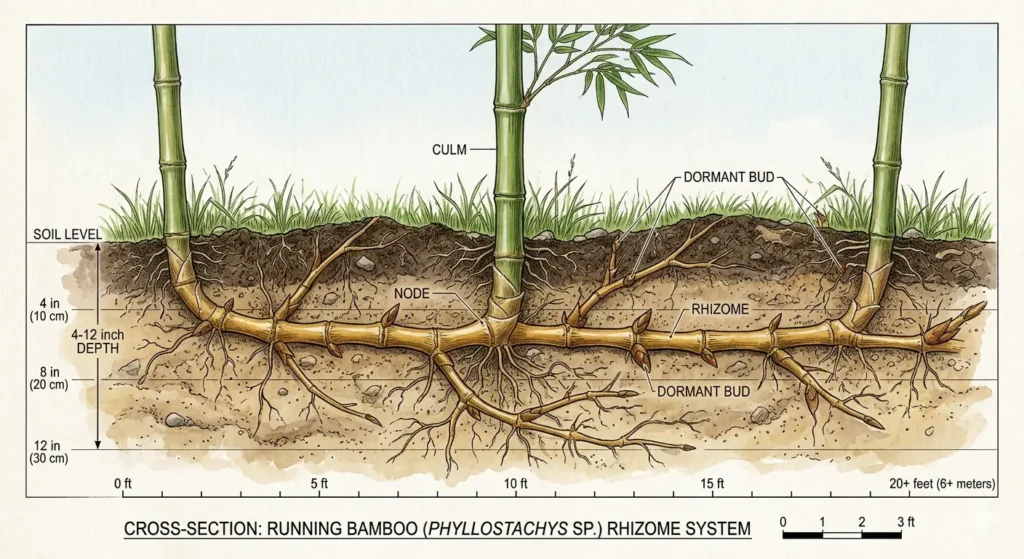
Removing established running bamboo (Phyllostachys species) requires eliminating the underground rhizome network, which extends 3-20 feet beyond visible culms. Complete removal takes 2-4 years using repeated cutting plus targeted herbicide, or $5,000-$15,000 for professional excavation with rhizome tracking. There’s no quick fix, anyone promising otherwise is selling something.
I’ve spent twelve years managing running bamboo on my Zone 7a property, first trying to contain it, then helping three neighbors remove it after containment failed. I’ve documented costs, tracked regrowth, and learned which methods actually work versus which just seem to work for the first season.
BambooScope has become my resource for sharing what this experience taught me, because I wasted years on advice that sounded authoritative but missed the underlying biology.
What you’ll learn here: why most removal fails, which methods work for different situations, realistic costs and timelines, and how to prevent the problem if you’re still in the planning stage.
Why Running Bamboo Is So Difficult to Remove
The difficulty isn’t the bamboo itself, it’s the rhizome architecture that running bamboo species evolved over millions of years.
Running bamboo belongs to species with leptomorph rhizomes: underground stems that grow horizontally, often 4-6 feet per year in established groves. Phyllostachys aureosulcata (Yellow Groove Bamboo) can send rhizomes 15-20 feet from the parent plant in a single growing season. These rhizomes sit 2-12 inches deep, store massive energy reserves, and contain dozens of dormant buds that activate when the plant is stressed.
Cut the culms? The rhizomes send up new shoots. Dig out the visible grove? Any rhizome fragments left behind regenerate. Apply herbicide once? Surviving sections resprout next season.
This isn’t a defect, it’s exactly how Phyllostachys species survived ice ages and wildfire. Your removal strategy is fighting 20 million years of evolutionary optimization.
Removal isn’t about killing what you can see. It’s about exhausting the rhizome network’s energy reserves over multiple growing seasons. Any single-application method, one excavation, one herbicide treatment, one season of cutting, almost always fails.
The Exhaustion Method: Slow, Cheap, and Actually Effective
I used to think this approach was too slow to be practical. Then I watched my neighbor’s expensive excavation fail while my $200 exhaustion method succeeded over three years.
How it works: Every time a bamboo shoot emerges, it draws energy from the rhizome network. By cutting every shoot as soon as it appears, before leaves unfurl and begin photosynthesis, you force the rhizomes to spend energy without replenishing it. After 2-3 years of consistent cutting, the rhizome network starves.
My protocol (Phyllostachys bissetii, Zone 7a, 400 sq ft grove):
| Season | Action | Time Investment |
| Year 1 Spring | Cut all culms at ground level | 4 hours |
| Year 1 (Apr-Jul) | Cut new shoots weekly at 6-12 inches | 30 min/week |
| Year 1 (Aug-Oct) | Cut any stragglers biweekly | 15 min/week |
| Year 2 | Repeat; expect 60-70% fewer shoots | 20 min/week average |
| Year 3 | Spot treatment only; most rhizomes exhausted | 2-3 hours total |
Total cost: $0-$50 (loppers, maybe a mattock)
Total active time: ~60 hours over 3 years
Success rate in my observation: 90%+ when done consistently
The catch? You cannot miss weeks. I’ve seen this method fail three times, every failure traced to a 3-4 week gap (vacation, injury, lost motivation) that allowed leaves to photosynthesize and recharge the rhizomes.
For larger groves, use a string trimmer or brush cutter to knock down shoots faster. The goal is speed, not precision, you’re not pruning, you’re starving.
Herbicide Application: When, What, and Why Most People Do It Wrong
I resisted herbicides for years. Then I inherited a 1,200 square foot Phyllostachys aureosulcata infestation from a previous owner, and exhaustion-only wasn’t practical.
The mistake everyone makes: Spraying glyphosate on bamboo leaves during active growth. The leaves’ waxy coating and the plant’s compartmentalized vascular system mean maybe 10-20% of the chemical reaches the rhizomes. You kill the foliage, the shoots die back, and you think it worked, until next April.
What actually works: Cut-stump treatment in late summer or early fall (August-October in Zones 6-8). Here’s why:
- Timing: In late summer, bamboo is actively transporting sugars downward to rhizomes for winter storage. Herbicide hitchhikes on this flow.
- Method: Cut culms 2-4 inches above ground. Immediately (within 5 minutes) apply concentrated herbicide, glyphosate 41%+ or triclopyr, directly to the cut surface.
- Concentration: I use undiluted glyphosate concentrate on fresh cuts. The Penn State Extension recommends 50%+ concentration for woody plants.
Results from my 2018-2020 removal:
- September 2018: Cut 200+ culms, treated stumps same day
- Spring 2019: ~40% shoot emergence (expected, rhizome sections survived)
- September 2019: Repeat treatment on regrowth
- Spring 2020: 8 shoots total
- September 2020: Final treatment
- 2021-present: Zero regrowth
Cost: ~$150 (herbicide, sprayer, loppers, gloves)
Time: 15-20 hours over 3 years
Important caveat: Glyphosate kills everything it contacts. I lost a mature hydrangea whose roots had grown into the bamboo zone. Triclopyr is more selective but less effective on Phyllostachys in my testing. For removal near desirable plants, the exhaustion method is safer.
Professional Excavation: When It’s Worth $10,000+
Sometimes you need the bamboo gone now, selling a house, neighbor threatening legal action, or the grove is simply too large for manual methods.
Professional removal using excavators and rhizome tracking typically costs:
| Grove Size | Typical Cost | What’s Included |
| Under 200 sq ft | $2,000-$4,000 | Excavation, rhizome removal, soil screening, disposal |
| 200-500 sq ft | $4,000-$8,000 | Above + extended rhizome tracking (10-15 ft perimeter) |
| 500-1,000 sq ft | $8,000-$15,000 | Above + soil replacement, possible stump grinding |
| 1,000+ sq ft | $15,000+ | Custom quote; often phased removal |
The hidden variable: soil type. Sandy or loamy soil allows equipment to screen and separate rhizomes efficiently. Clay soil, what I have in Virginia, traps rhizome fragments that regenerate. My neighbor’s $4,800 failure was partly because the contractor quoted based on square footage without assessing soil composition.
Questions to ask any contractor:
- “How do you track rhizomes beyond the visible grove?” (Good answer: soil probing, root inspection trenches, or ground-penetrating assessment)
- “What’s your warranty against regrowth?” (Reputable companies offer 1-2 year guarantees with re-treatment)
- “How deep will you excavate?” (Should be 18-24 inches minimum; 12 inches isn’t enough for established Phyllostachys)
My current recommendation: Get 3 quotes, ask about their bamboo species identification, and check whether they’ll warranty against specific species. A contractor who can’t identify Phyllostachys nigra versus Phyllostachys aureosulcata doesn’t understand what they’re removing.
The “Smothering” Method: Does Tarping Actually Work?
I tested this. Sort of.
The claim: Cover bamboo with thick tarps or landscape fabric for 1-2 years. Deprive rhizomes of light, and they’ll die.
My 2017-2019 test on a 15×15 foot Phyllostachys vivax section:
- August 2017: Covered with 6 mil black plastic, edges buried 6 inches
- October 2017: Shoots pushing up tarp edges at multiple points
- December 2017: Reinforced edges with sandbags
- April 2018: Shoots emerging through any gap, pushing plastic up 12+ inches
- June 2018: Abandoned test
The rhizomes didn’t die. They traveled laterally under the tarp, emerged at the edges, and the shoots that reached light fed the entire network. After 10 months, I had bamboo erupting in a ring around my tarp.
Why guides still recommend it: It works on young bamboo with limited rhizome networks, and it works on small clumping bamboo (Fargesia, Bambusa in pots). But for established running bamboo? The rhizomes hold enough stored energy to survive 2+ years of darkness and will find edges, gaps, or weak points.
If you want to try tarping: only on bamboo under 2 years old, with tarps extending 10+ feet past visible growth, with weekly edge inspection. Otherwise, you’re giving the rhizomes a protected corridor to escape.
Containment: If You’re Keeping Some Bamboo
Maybe you don’t want removal, you want the bamboo to stay where you planted it. After watching four containment systems succeed and three fail, here’s what separates them.
The barrier that works: 60-80 mil HDPE (high-density polyethylene), installed 28-36 inches deep, angled outward 15 degrees at the top, with 2-4 inches exposed above soil level.
Why lesser barriers fail:
- Depth: Phyllostachys rhizomes typically run 4-12 inches deep, but stressed rhizomes dive deeper. My neighbor’s 18-inch barrier was breached at 22 inches by Year 4.
- Thickness: 40 mil plastic degrades and tears within 5-8 years. Rhizome tips, while not sharp, exert continuous pressure. I’ve seen 40 mil barriers perforated like Swiss cheese.
- Seams: Overlapped seams separate. Use barrier tape or single continuous pieces where possible.
Annual maintenance (non-negotiable):
Every August-September, I trench around my contained bamboo and sever any rhizomes approaching the barrier. This takes 2-3 hours yearly. Skip this, and rhizomes will eventually find a way over or under.
For detailed installation guidance, the bamboo container growing guide covers above-ground alternatives that eliminate escape risk entirely.
The Legal Reality: What Happens When Bamboo Crosses Property Lines
This isn’t hypothetical. I’ve watched two neighbor disputes over bamboo, and one went to small claims court.
In most U.S. states, the bamboo owner is responsible for preventing spread onto neighboring property. Several states, New York, Connecticut, Rhode Island, parts of New Jersey, have enacted bamboo-specific ordinances requiring containment or removal.
Practical implications:
- If your bamboo crosses the property line, neighbors can bill you for removal (amounts vary by jurisdiction)
- Some localities fine homeowners $100+/day for uncontained running bamboo
- “It was here when I bought the house” typically isn’t a defense for ongoing spread
If you’re dealing with a neighbor’s bamboo invading your property, document everything: photos with dates, written notices to the neighbor, professional assessments. Most states allow you to remove rhizomes up to the property line, but check local regulations before digging.
What I’d Do Differently
Starting over with what I know now, I’d never plant running bamboo in the ground. Period.
The aesthetics are beautiful. Phyllostachys nigra is stunning. But the containment maintenance, the neighbor anxiety, the eventual removal cost, it’s not worth it for residential properties.
For privacy screens, I’d choose clumping bamboo varieties (Fargesia robusta, Bambusa oldhamii in Zone 8+) or keep running species in large containers or raised beds with concrete bottoms.
If you’re facing removal of existing running bamboo: start with the exhaustion method if you have 2-3 years. Add herbicide stump treatment for faster results. Save professional excavation for deadline situations or groves over 500 square feet where manual methods aren’t practical.
Whatever method you choose, plan for years, not months. That’s the honest timeline nobody wants to hear, but it’s the one that actually works.