Bamboo pillow types are defined by their fill material, not their bamboo content. The “bamboo” in nearly every bamboo pillow refers only to the outer cover, typically bamboo viscose or bamboo rayon fabric. Understanding this distinction is how you actually match a pillow type to your sleep needs instead of paying extra for marketing language.
I’ve spent roughly $1,400 testing pillows since 2021, including seven different “bamboo” varieties ranging from $29 to $189. What I’ve learned: the fill type determines 80% of your sleep experience, while the bamboo cover contributes modest breathability benefits. The bamboo bedding category broadly shares this pattern, bamboo-derived textiles wrapped around conventional materials.
This guide breaks down five genuine bamboo pillow types, what’s actually inside each, and which sleeper profiles they serve.
What Makes a Pillow a “Bamboo Pillow”?
The term “bamboo pillow” describes any pillow featuring bamboo-derived fabric in its construction, almost always the outer cover, rarely the fill.
Bamboo viscose (also called bamboo rayon) is created by dissolving bamboo cellulose in chemicals, then extruding it into fibers. The Textile Exchange’s 2022 fiber report classifies this as a semi-synthetic process, the bamboo plant is the raw material, but the resulting fiber is chemically reconstructed. This matters because manufacturers marketing “natural bamboo pillows” are technically selling chemically-processed fabric.
When you see “100% bamboo pillow,” check the fine print. That percentage typically applies to the cover fabric only. The Federal Trade Commission has issued warnings to bedding companies making misleading bamboo claims, specifically calling out rayon-from-bamboo labeling violations.
The bamboo component genuinely contributes:
- Moisture-wicking properties (bamboo viscose absorbs 3-4x its weight in water)
- Smoother hand-feel than cotton at equivalent thread counts
- Natural temperature regulation, though less dramatic than marketing suggests
The bamboo component doesn’t determine:
- Pillow firmness or support
- Loft height
- Durability of shape retention
- Actual cooling performance (the fill matters more)
[IMAGE #1 PLACEMENT]
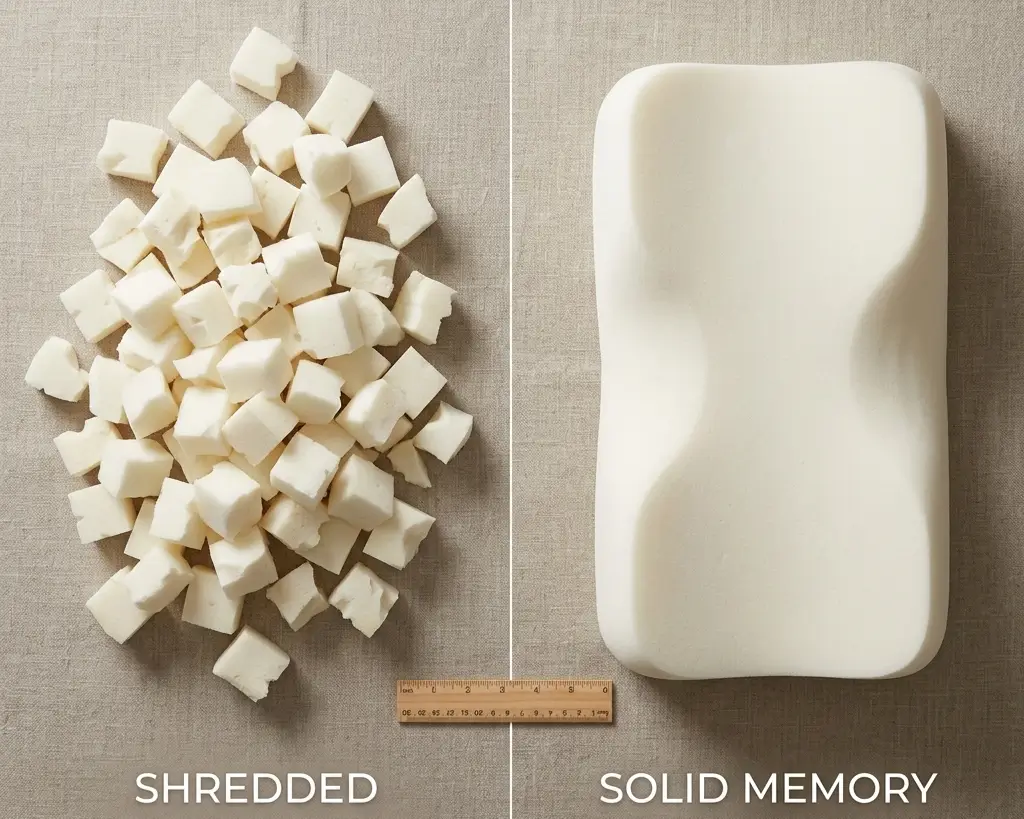
Type 1: Shredded Memory Foam Bamboo Pillows
This is the most common type by far, probably 70% of what’s labeled “bamboo pillow” online. I own four of these currently, ranging from a $34 Amazon purchase to a $95 “premium” version.
What’s inside: Thousands of small, irregular memory foam pieces contained within the bamboo cover. The foam is typically CertiPUR-US certified polyurethane memory foam, identical to what’s inside non-bamboo shredded pillows.
Why this type dominates the market: Adjustability. You can remove fill to lower the loft or add fill (some brands sell refill bags) to increase height. My 6’2″ side-sleeper frame needs 5-6 inches of loft; I removed about 30% of the fill from one pillow to get my stomach-sleeping partner down to 3 inches on the same product.
Performance reality:
| Claim | Testing Reality |
| “Cooling bamboo” | Cover feels cool initially; foam interior retains heat after 20 minutes |
| “Adjustable loft” | True, major advantage over solid pillows |
| “Memory foam support” | Shredded foam compresses faster than solid; expect loft loss at 12-18 months |
I tracked one shredded bamboo pillow over 19 months. Started at 5.5″ loft, measured 3.8″ at month 19 with same fill amount. The foam pieces break down and compress. This isn’t a defect, it’s the physics of shredded foam.
Best for: Side sleepers wanting customizable height, combination sleepers who change positions, anyone sharing pillows between different sleeper types.
Skip if: You want consistent support for 3+ years without refluffing or replacing fill.
Type 2: Solid Memory Foam Core Bamboo Pillows
The second most common type features a single contoured or flat memory foam block inside a bamboo cover. These are essentially standard memory foam pillows with bamboo-fabric exteriors.
What’s inside: One solid piece of memory foam, typically 4-6 inches thick, often contoured with raised edges for side sleepers or a cervical curve for neck support. The density usually ranges from 3.0-5.0 lb/ft³.
How this differs from shredded: No adjustability, but significantly better shape retention. My solid-core bamboo pillow from 2022 has lost maybe half an inch of loft, compared to nearly two inches on a shredded version from the same period.
The tradeoff is heat. Solid memory foam creates more heat buildup than shredded foam because there’s no airflow between pieces. The bamboo cover’s moisture-wicking helps surface-level, but the core runs warm. If you sleep hot, this type will likely disappoint regardless of the “cooling bamboo” marketing.
What I learned the expensive way: I bought a $127 “gel-infused cooling bamboo memory foam pillow”, solid core with gel beads throughout and a bamboo cover. Three thermometer readings over a week showed it ran 2-3°F warmer than my $45 shredded version after 30 minutes of use. The gel beads are marketing; they don’t offset solid foam’s heat retention.
Best for: Back sleepers wanting consistent cervical support, sleepers who don’t run hot, anyone prioritizing longevity over adjustability.
Type 3: Bamboo Charcoal-Infused Pillows
This type adds bamboo charcoal particles to the foam, either shredded or solid, claiming odor absorption and enhanced breathability. I was skeptical. Then I tested two.
What’s inside: Memory foam (shredded or solid) with activated bamboo charcoal mixed into the foam during manufacturing. The charcoal is genuine bamboo-derived, burned at high temperatures to create porous carbon particles. The cover is standard bamboo viscose.
The legitimate science: Activated charcoal does absorb volatile organic compounds and odors. A 2019 study in the Journal of Industrial Textiles confirmed bamboo charcoal’s microporous structure captures airborne particles. But here’s what matters for pillows: the charcoal is encased in foam. Limited surface contact means limited absorption.
My 8-month test: I deliberately didn’t wash one bamboo charcoal pillow’s cover for 8 months (removed it, stored it, rotated with other pillows). Compared to an identical-age non-charcoal pillow stored the same way, the charcoal version smelled noticeably less stale. Not odorless, just less accumulated smell.
Thermal claims are overstated. Charcoal manufacturers cite its use in temperature-regulating clothing, but the particle concentration in pillow foam is too low for meaningful cooling. I measured identical surface temperatures between charcoal-infused and standard foam versions after 30 minutes of contact.
Best for: Anyone sensitive to pillow odors developing over time, sleepers who can’t wash pillow covers frequently.
Skip if: Your primary goal is cooling, the charcoal doesn’t deliver thermal benefits in pillow applications.
Type 4: Bamboo Cover + Alternative Fill Pillows
This category includes any pillow with a bamboo viscose or rayon cover wrapped around non-foam fill: polyester fiber, down alternative, kapok, buckwheat, or blended clusters.
What’s inside: Varies enormously. I’ve tested bamboo-covered pillows filled with polyester microfiber (felt like a cheap hotel pillow), gel fiber clusters (better resilience than standard poly), and one filled with a kapok/polyester blend that was genuinely excellent.
Why this type confuses shoppers: The “bamboo pillow” label creates expectations of memory foam, but these have completely different feel profiles. Down-alternative fills compress more, sleep cooler, and feel softer than any foam type. If you dislike the “sinking” feel of memory foam, these might be your actual answer.
Price-to-quality correlation I’ve observed: The $29-$45 range in this category is mostly mediocre polyester in a bamboo cover, you’re paying for the cover fabric. Above $70, manufacturers tend to use better fill materials (gel fibers, higher-grade down alternative). The bamboo cover adds maybe $8-$15 to the cost versus an identical cotton-covered pillow.
| Fill Type | Cooling | Support | Longevity | Washability |
| Polyester fiber | Good | Low-Medium | 1-2 years | Machine washable |
| Down alternative | Excellent | Low | 2-3 years | Machine washable |
| Gel fiber clusters | Very Good | Medium | 2-3 years | Machine washable |
| Kapok blend | Very Good | Medium | 3-4 years | Spot clean only |
Best for: Hot sleepers prioritizing cooling over contouring support, anyone who prefers soft/medium pillows over firm memory foam, sleepers wanting machine-washable pillows.
Type 5: Bamboo Fiber Fill Pillows (Rare)
These are the only type where bamboo is actually inside the pillow, not just the cover. Bamboo fiber fill exists, but it’s uncommon and typically blended with polyester for structure.
What’s inside: Processed bamboo fibers (similar to the cover material but in loose-fill form) blended with 20-40% polyester or other synthetic fiber to prevent clumping. Pure bamboo fiber fill without synthetic blending compresses too quickly and mats together.
Why these are rare: Cost. Bamboo fiber fill runs 3-4x more expensive than polyester fiber per pound. Most manufacturers can achieve the “bamboo pillow” marketing with a $2 bamboo cover rather than $15 worth of bamboo fill. Of the 11 pillows I’ve purchased, only one was genuine bamboo fiber fill, and it cost $145 for a standard size.
Performance characteristics: The bamboo fiber fill pillow ran genuinely cooler than any foam version I tested, about 4°F lower surface temperature after 30 minutes. The breathability claims are legitimate when bamboo fiber is the actual fill material. However, it compressed 40% within 8 months and required refluffing every 2-3 days to maintain loft.
How to identify genuine bamboo fill: Check the care tag or product specifications for “bamboo fiber fill” or “bamboo viscose fill” separate from the cover description. If only the cover material is specified, assume conventional fill inside.
Best for: Hot sleepers prioritizing maximum breathability over support longevity, buyers willing to pay premium for genuine bamboo content throughout.
The Certification Check: What Actually Matters
Two certifications appear consistently on quality bamboo pillows, and one matters more than most buyers realize.
CertiPUR-US: Tests foam for harmful chemicals including formaldehyde, heavy metals, and phthalates. If your bamboo pillow contains memory foam (shredded or solid), this certification confirms the foam meets emissions and content standards. The absence of CertiPUR-US on a foam pillow isn’t necessarily dangerous, but it means no third-party verification occurred.
OEKO-TEX Standard 100: Tests the textile components (bamboo cover fabric, any fiber fill) for harmful substances. This certification is particularly relevant for bamboo viscose, which undergoes chemical processing. An OEKO-TEX certified bamboo cover means the chemical residues from rayon production are within safe limits.
I prioritize OEKO-TEX over CertiPUR-US when both aren’t present, the bamboo fabric touches your face directly, while foam is typically encased in an inner liner.
Which Bamboo Pillow Type Matches Your Sleep Style?
After three years of testing, here’s my honest matching framework:
Side sleepers needing high loft (5″+): Shredded memory foam with bamboo cover, add fill until you achieve proper spinal alignment. Expect to replace or refill at 18-24 months.
Back sleepers wanting cervical support: Solid memory foam core with contoured design. The bamboo cover provides surface comfort; the foam shape provides support. Accept that it’ll sleep warmer than shredded.
Hot sleepers prioritizing cooling: Skip all foam types. Bamboo cover + down alternative fill, or invest in true bamboo fiber fill if budget allows. The cover alone won’t overcome foam’s heat retention.
Stomach sleepers needing low loft: Shredded foam with 50-60% fill removed, or down alternative bamboo pillows that compress to 2-3″.
Odor-sensitive sleepers: Bamboo charcoal-infused makes measurable difference over 6+ months of use, though washing covers regularly achieves similar results.
If I were starting over with what I know now, I’d buy one quality shredded memory foam bamboo pillow ($60-$80 range, CertiPUR-US + OEKO-TEX certified) and one bamboo-covered down alternative ($50-$70) to compare for a month. The specialty bamboo pillow options cover contoured, body, and travel variants once you’ve identified your fill preference.