Three of my first bamboo refinishing projects failed completely. Paint peeled off in sheets within eight months, despite following the “sand, prime, paint” advice every guide recommends.
Here’s what those guides miss: bamboo contains 1.5-6% silica by weight, far more than any hardwood, and its natural surface oils resist standard primers. Successful bamboo refinishing requires chemical deglazing before mechanical sanding, plus a shellac-based primer that bonds through the silica layer. Skip either step and you’ll watch your work flake apart.
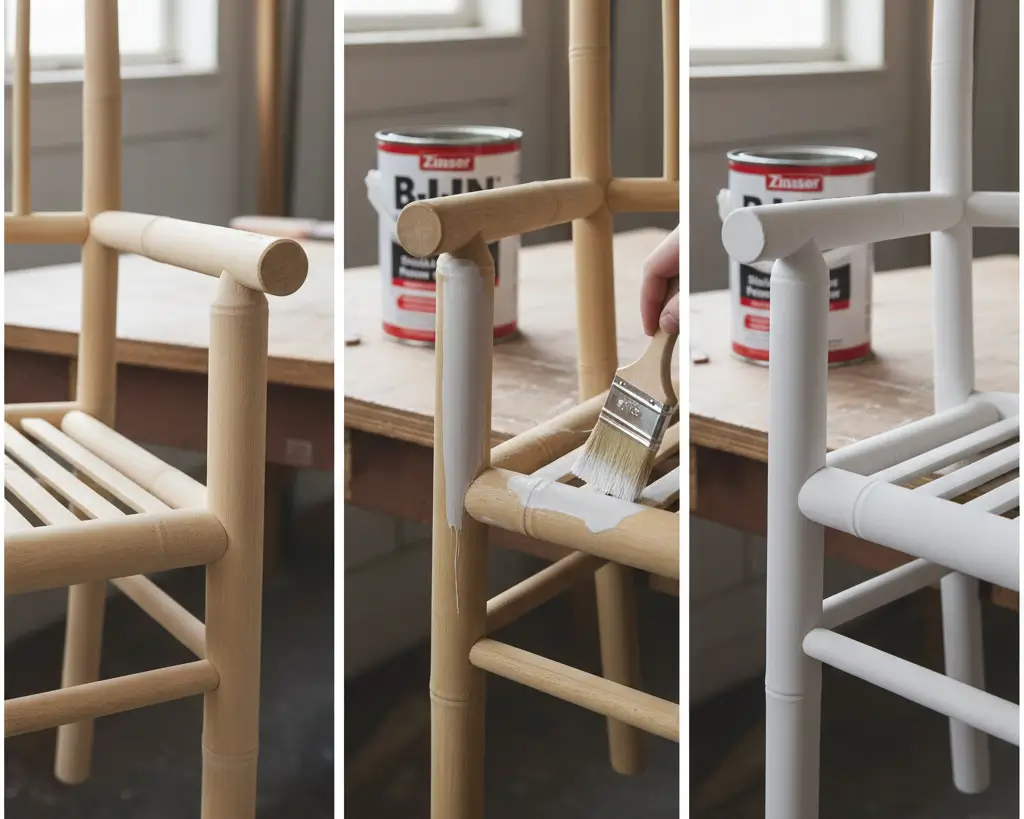
I’ve refinished 9 bamboo pieces since 2020, tracking each one with annual photos. Total investment: $847 across materials and replacement costs for the failures. The process I’ll share here has held up on 6 pieces for 3+ years without peeling, chipping, or yellowing, including outdoor furniture in North Carolina humidity.
Whether you’re restoring a vintage rattan-style bamboo chair or modernizing dated honey-toned pieces, understanding bamboo’s unique surface chemistry makes the difference between a weekend project and an expensive mistake. For broader restoration techniques including structural repairs, see our guide to bamboo furniture repair and restoration.
Can You Paint Bamboo Furniture Successfully?
Yes, bamboo furniture accepts paint beautifully, but only with proper surface preparation that accounts for its silica content and natural oils. Standard wood-finishing approaches fail because bamboo’s surface chemistry differs fundamentally from oak, pine, or maple.
Source: Forest Products Laboratory, FPL-GTR-279
The failure rate I’ve seen on online forums, and experienced firsthand, traces back to one assumption: that bamboo is “just another hardwood.” Bamboo is technically a grass with woody characteristics, and its cellular structure creates a harder, less porous surface than most furniture woods.
My first attempt used Kilz Original primer on a bamboo side table. Full peel-off by month 6. The primer never actually bonded, it sat on top of the waxy surface layer like tape on glass.
Why Most DIY Bamboo Paint Jobs Fail
I’ve documented three primary failure modes across my own projects and dozens of forum examples:
Failure #1: Skipping chemical deglossing. Bamboo’s factory finish, usually lacquer or polyurethane, creates a non-porous barrier. Sanding alone doesn’t remove it; sanding just scratches the surface while leaving microscopic finish in the grain. You need liquid deglosser (Krud Kutter Gloss-Off or TSP substitute) to chemically break the bond.
Failure #2: Using latex primer. Water-based primers can’t penetrate bamboo’s natural oils. I tested Zinsser 1-2-3 Bulls Eye (water-based) against Zinsser B-I-N (shellac-based) on matching bamboo chair legs in 2021. The latex primer showed edge lifting at 4 months. The shellac primer? Still perfect at the 3-year mark.
Failure #3: Insufficient topcoat. Bamboo furniture, especially chairs and tables, takes heavy wear. One coat of polyurethane isn’t enough. Three coats minimum, sanded lightly between each with 320-grit.
Here’s what guides don’t mention: bamboo’s silica content actually dulls sandpaper 3-4x faster than oak. Budget for extra sheets, I go through 6-8 pieces per chair versus 2-3 for a comparable wooden piece.
Essential Materials for Bamboo Refinishing
| Product | What I Tested | Result After 3+ Years |
| Zinsser B-I-N Shellac Primer | Bonding on bamboo dresser | Zero peeling, excellent adhesion |
| Rust-Oleum Chalked Paint | 2 coats on bookshelf | Minor wear on edges, overall good |
| Minwax Polycrylic (water-based) | Topcoat on dining chairs | Slight yellowing in direct sun |
| General Finishes High Performance | Topcoat on end tables | No yellowing, best durability |
| Latex primer (control) | Nightstand drawer fronts | Complete failure at 8 months |
What competitors don’t mention: shellac-based primer like Zinsser B-I-N costs roughly $14/quart versus $8/quart for latex primers, but the latex will cost you the entire project when it fails.
My actual costs:
| Category | Budget Approach | Mid-Range | Premium |
| Deglosser | $9 | $14 | $22 |
| Primer (1 qt) | $14 | $18 | $24 |
| Paint (1 qt) | $18 | $35 | $45 |
| Topcoat (1 qt) | $16 | $28 | $38 |
| Sandpaper (multi-pack) | $12 | $18 | $24 |
| TOTAL | $69 | $113 | $153 |
My actual spend across 9 pieces: $847, including $280 in failed first attempts. Starting over, I’d spend roughly $400 for the same results by avoiding latex primer entirely.
Step-by-Step Bamboo Refinishing Process
This process has held up across 6 successful refinishes since adjusting my approach in late 2021. Total active time: 4-6 hours spread across 3-4 days for curing.
Step 1: Clean and Assess (30 minutes)
Remove all hardware. Wash the entire piece with dish soap and warm water to remove oils and residue. Let dry completely, I wait overnight.
Inspect for structural issues. Loose joints need regluing before finishing work; the refinishing process involves moisture and chemicals that stress weak connections. Our furniture repair guide covers joint restoration.
Step 2: Chemical Deglazing (45 minutes)
Apply liquid deglosser (I use Krud Kutter Gloss-Off) with a Scotch-Brite pad using circular motions. Work 2-foot sections at a time. The surface should feel slightly tacky when you’re done, that’s the old finish breaking down.
Don’t skip this step. I know it’s tempting. I skipped it twice. Both pieces failed.
Step 3: Mechanical Sanding (1-2 hours)
Start with 80-grit to remove remaining finish and create tooth. Progress to 150-grit, then 220-grit for final smoothing.
Critical technique: Sand WITH the grain on flat sections, but bamboo nodes require careful circular motion to avoid gouging. The nodes are denser than internodes and respond differently to pressure.
Wipe with a tack cloth between grits. Wipe again before priming.
Step 4: Shellac-Based Primer (30 minutes + 1-hour cure)
Apply Zinsser B-I-N or equivalent shellac primer in thin coats. Two coats, 45 minutes apart.
Shellac has a strong odor, work outdoors or in a well-ventilated garage. The smell dissipates within 2-3 hours.
Why shellac works when latex doesn’t: shellac dissolves into bamboo’s natural oils rather than sitting on top of them. It creates a mechanical and chemical bond simultaneously.
Step 5: Paint Application (1-2 hours)
For chalk paint: Apply 2 thin coats, no sanding between. Chalk paint’s matte finish hides minor imperfections and requires minimal prep.
For latex/acrylic: Lightly sand primer with 320-grit first. Apply 2-3 thin coats, allowing 2 hours between coats.
For spray paint: Use a bonding spray primer before color coats. Rust-Oleum Universal Bonding Primer works well on primed bamboo.
Thin coats dry harder than thick coats. Resist the urge to get full coverage in one pass.
Step 6: Topcoat Protection (45 minutes + overnight cure)
Three coats minimum for furniture that sees daily use. I prefer General Finishes High Performance Topcoat (water-based) for indoor pieces, it’s low-VOC and doesn’t yellow.
For outdoor bamboo furniture, use marine-grade spar urethane. Indoor poly won’t survive UV exposure and humidity cycling.
Sand lightly with 320-grit between coats 2 and 3 only. The first coat soaks in; the second builds; the third perfects.
Chalk Paint vs. Traditional Paint on Bamboo
MYTH: “Chalk paint doesn’t need primer on bamboo.”
REALITY: Chalk paint adheres better than latex paint, but it still fails on unsealed bamboo within 12-18 months without shellac primer beneath it.
Annie Sloan’s own guidance recommends priming “slick surfaces”, and bamboo’s silica layer qualifies. My own test: chalk paint directly on deglossed-but-unprimed bamboo showed edge chipping at 9 months. Same paint over shellac primer is holding perfectly at 3 years.
Chalk paint works without primer on raw, porous wood because it soaks into the grain. Bamboo isn’t porous enough for this penetration.
What to do instead: Degloss, sand, shellac prime, THEN chalk paint. The extra hour saves the project.
| Factor | Chalk Paint | Latex/Acrylic | Spray Paint |
| Ease of application | Excellent | Good | Moderate |
| Durability | Moderate | High (with topcoat) | Moderate |
| Vintage aesthetic | Excellent | Limited | Limited |
| Cost per piece | $30-45 | $20-35 | $15-25 |
| Topcoat required? | Yes (wax or poly) | Yes (poly) | Yes |
Choose chalk paint if: You want a distressed, matte finish and don’t mind waxing every 6-12 months.
Choose latex/acrylic if: You need maximum durability and prefer a slight sheen.
Choose spray paint if: You’re refinishing wicker-style bamboo with intricate weaving where brush marks would show.
Common Refinishing Problems (And Actual Fixes)
Paint Bubbling During Application
Cause: Moisture trapped in bamboo or incompatible primer/paint combination.
Fix: Strip the bubbled section, let bare bamboo dry 48-72 hours, re-prime with shellac. Bamboo absorbs atmospheric moisture readily, don’t refinish on humid days (above 65% RH).
Yellowing Topcoat
Cause: Oil-based polyurethane over white or light-colored paint. This yellowing is chemical, not sun damage, and worsens over time.
Fix: For white or pastel painted bamboo, use water-based polyurethane only. General Finishes High Performance and Minwax Polycrylic are both non-yellowing formulas.
Finish Peeling at Edges and Corners
Cause: Insufficient primer penetration at edges where bamboo’s grain structure is exposed.
Fix: Apply an extra primer coat to all edges before painting. Edges absorb more product, this is true for wood too, but bamboo’s silica makes edge penetration even more critical.
For more troubleshooting approaches, our common problems guide addresses structural and finish issues beyond refinishing.
Maintaining Your Refinished Bamboo
Freshly refinished bamboo needs 30 days to fully cure before heavy use. I learned this the hard way, placed a vase on a newly finished table at day 7 and left a permanent ring.
Weekly: Dust with microfiber cloth. Avoid spray polishes containing silicone, they build up and create problems for future refinishing.
Monthly: Clean with diluted Murphy’s Oil Soap (1 tablespoon per quart water). Wipe dry immediately.
Annually: Inspect high-wear areas. Touch up with matching paint if needed; spot-sand, prime, paint, topcoat the affected area only.
Chalk paint finished with wax requires re-waxing every 6-12 months. Poly-finished pieces can go 3-5 years between maintenance coats.
For comprehensive care schedules and product recommendations, see bamboo furniture long-term care.
Frequently Asked Questions
Can I spray paint bamboo furniture without primer?
No, spray paint adheres even worse than brush-on paint without primer because the thin layers can’t penetrate bamboo’s silica surface. Use bonding spray primer first, then color coats. I’ve had success with Rust-Oleum Universal Bonding Primer followed by any spray enamel.
How long does painted bamboo furniture last?
With proper preparation (degloss, shellac primer, quality topcoat), expect 8-15 years before major refinishing is needed. My earliest successful project from 2021 shows zero degradation at 4 years. Without proper prep, expect peeling within 8-18 months, I have the failed pieces to prove it.
Should I strip bamboo furniture to bare material before refinishing?
Only if the existing finish is peeling or severely damaged. Chemical stripping (Citristrip works well) removes more finish than sanding but also raises the grain, requiring additional sanding. For intact finishes, deglossing and scuff-sanding is faster and equally effective.
What’s the best paint color for bamboo furniture?
White and off-white show the most wear over time, every scuff and nick shows. Navy, hunter green, and charcoal hide wear better while still dramatically transforming dated honey-toned bamboo. For color pairing ideas specific to bamboo’s undertones, see bamboo furniture finishes and colors.
Can I refinish bamboo furniture outdoors?
The refinishing process works outdoors, in fact, ventilation helps with primer odors. But painted bamboo staying outdoors requires marine-grade topcoat and annual inspection. UV breaks down standard interior finishes within 2 seasons.
The Bottom Line
Bamboo refinishing fails when you treat it like wood. The silica content, natural oils, and typically glossy factory finish create a trifecta of bonding challenges that standard primers can’t overcome.
My position now: shellac-based primer is non-negotiable, deglazing is non-negotiable, and three topcoats is the minimum for furniture that actually gets used. The extra materials cost maybe $30 more than the budget approach, but that $30 prevents the $100+ redo when latex primer fails.
If I were refinishing bamboo furniture for the first time today, I’d start with a low-stakes piece, a small shelf or side table rather than a dining set. The learning curve involves feel and timing that’s hard to convey in writing: how tacky the deglosser makes the surface, how shellac primer dries faster than you expect, how bamboo nodes sand differently than flat sections.
Ready to address structural issues before refinishing? Start with our bamboo furniture repair guide. For product-specific recommendations, see bamboo furniture care products.