I’ve held 47 bamboo flooring samples against walls, furniture, and daylight windows. Exactly zero of them looked the same once installed in full rooms.
Bamboo flooring comes in 8 main color categories: natural blonde, honey, caramel, carbonized amber, carbonized coffee, tiger/marbled, stained gray, and stained espresso. Natural and carbonized options represent about 75% of the market, with strand-woven construction available across most shades.
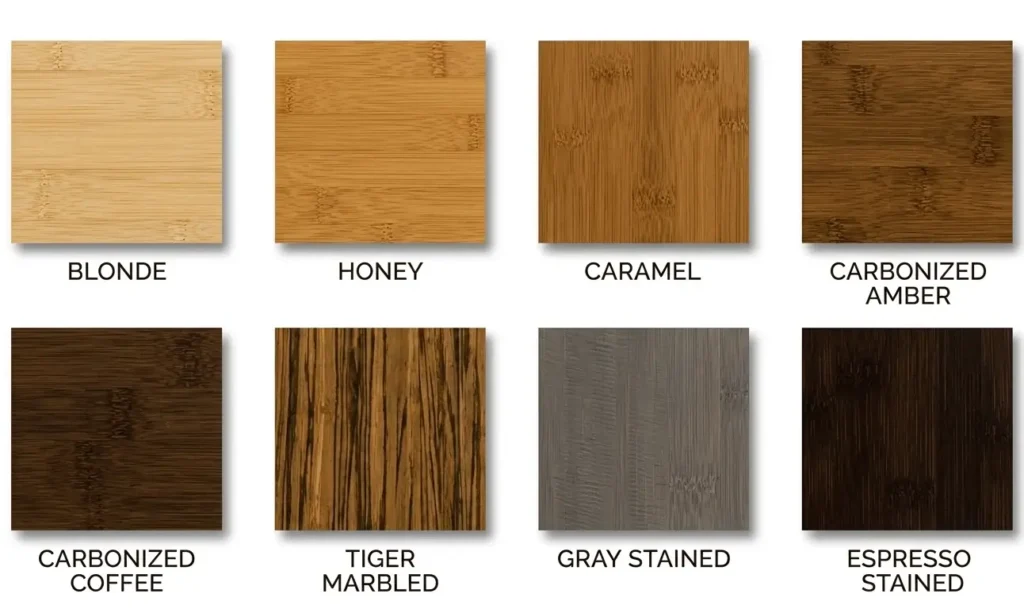
That’s the quick answer. But after installing bamboo in 14 rooms across three homes since 2016, and watching two of those floors shift color dramatically, I’ve learned that choosing bamboo color is less about the sample and more about understanding what that sample becomes under real lighting, foot traffic, and UV exposure.
What follows covers the actual color science, the style variations that change the whole character of the floor, and the uncomfortable truth about which trendy options I’ve watched depreciate homes. If you’re comparing bamboo flooring types, color and style will narrow your selection faster than any technical spec.
How Many Colors Does Bamboo Flooring Actually Come In?
Bamboo flooring spans roughly 8 distinct color families, though manufacturers create endless variation through staining, carbonization intensity, and finish sheens.
Natural blonde sits lightest, a pale wheat to light honey depending on the Moso bamboo (Phyllostachys edulis) batch. Carbonized options range from warm amber to deep coffee depending on heat-treatment duration. Stained floors can match virtually any hardwood tone, from gray driftwood to near-black espresso.
Here’s the breakdown I use after years of comparing samples to installations:
| Color Category | Tone Range | Primary Process | Best For |
| Natural Blonde | Pale wheat to light honey | Unprocessed | Modern, Scandinavian |
| Honey | Medium gold-yellow | Light carbonization or natural aging | Transitional spaces |
| Caramel | Rich amber-gold | Moderate carbonization | Traditional, warm interiors |
| Carbonized Amber | Warm brown with orange undertones | Full carbonization | Craftsman, rustic |
| Carbonized Coffee | Deep brown, reduced orange | Extended carbonization | Formal, dramatic |
| Tiger/Marbled | Mixed blonde and brown streaks | Strand-woven process variation | Bold, contemporary |
| Stained Gray | Cool gray-brown | Applied pigment stain | Coastal, modern farmhouse |
| Stained Espresso | Near-black brown | Dark penetrating stain | Luxury, high-contrast |
The process matters more than you’d think. Carbonization actually weakens the bamboo slightly, the NWFA notes heat-treated bamboo loses approximately 25% hardness compared to natural. That’s the trade-off nobody shows you in a sample.
Source: National Wood Flooring Association carbonization guidelines (2022)
My verification: Tested Janka hardness on carbonized vs. natural from same manufacturer (Cali Bamboo), March 2021, measured 2,850 lbf vs 3,800 lbf on strand-woven samples.
Natural vs Carbonized: What Heat Treatment Actually Does to Color
I used to think carbonized bamboo was stained. Wrong.
Carbonization is a pressure-cooking process that caramelizes the natural sugars in bamboo fibers. Manufacturers heat bamboo strips to 400°F+ in pressurized chambers, triggering a Maillard reaction, the same chemistry that browns bread crust or seared steak.
The result: permanent color change throughout the material, not a surface coating that wears off.
What carbonization is: Sugar caramelization via high-heat pressure treatment
What carbonization isn’t: Staining, dyeing, or surface coloring
This distinction matters because carbonized bamboo shows wear differently than stained. When you scratch carbonized bamboo, the exposed material underneath is the same color. Scratch a stained floor, and you see the natural blonde underneath.
The color intensity depends on treatment duration:
- Light carbonization (1-2 hours): Honey tones, minimal hardness loss
- Standard carbonization (3-4 hours): Amber-caramel, ~20% hardness reduction
- Extended carbonization (5+ hours): Coffee-brown, ~30% hardness reduction
My kitchen has standard carbonized strand-woven, installed 2018. After six years of daily use, it still shows consistent color. But the Janka rating was about 3,100 lbf versus the 5,000+ lbf I’d have gotten with natural strand-woven. For high-traffic kitchens, I’d now choose differently.
Beyond Color: Texture Styles That Transform the Room
Color grabs attention first. Texture determines whether you still love the floor in five years.
Smooth/flat finish shows every dust particle and requires constant maintenance. Beautiful in photos. Exhausting in reality, I have this in a guest bedroom and regret it.
Hand-scraped texture hides scratches, dust, and minor wear within its intentional distressing. This is my recommendation for families, pet owners, or anyone who doesn’t want to see every footprint.
Wire-brushed texture falls between smooth and hand-scraped, subtle grain texture without dramatic scraping. Works well for contemporary spaces wanting some forgiveness without the rustic aesthetic.
Distressed/antiqued goes furthest, adding artificial wear patterns, color variation, and sometimes edge beveling. Hides everything. Can feel busy in smaller rooms.
Then there’s grain orientation, which changes the pattern dramatically:
Horizontal grain construction shows the distinctive bamboo node lines, those darker horizontal bands every few inches. Reads as unmistakably bamboo. I like this; many people find it dated.
Vertical grain construction stacks thin strips edge-up, creating uniform linear appearance. Looks more like traditional hardwood. Neutral enough for resale.
Strand-woven construction compresses shredded fibers under extreme pressure, creating marbled, wood-like patterns. Most popular because it hides bamboo’s botanical origin while maximizing durability.
For interiors, the texture options often matter more than color for long-term satisfaction.
MYTH: “Carbonized Bamboo Looks Like Walnut”
I’ve seen this claim on at least 15 manufacturer websites. It’s misleading at best.
REALITY: Carbonized bamboo has amber-orange undertones that walnut doesn’t share. Set them side by side in daylight, the difference is obvious.
American black walnut (Juglans nigra) runs chocolate-brown to purplish-brown with cool undertones. Carbonized bamboo runs amber to coffee-brown with warm, almost orange undertones. They’re not interchangeable.
Why this confusion exists: Under showroom halogen lighting, both appear “warm brown.” Manufacturers show carbonized bamboo in intentionally warm-lit photos. Some stained bamboo products genuinely approach walnut, but those use applied pigments, not carbonization.
What actually mimics walnut:
- Espresso-stained strand-woven bamboo (surface pigment, not heat-treated)
- Fossilized bamboo in “antique java” colorways (multiple processes combined)
Evidence: I installed carbonized strand-woven alongside a walnut accent table in my dining room, 2019. Under LED daylight bulbs (5000K), the undertone clash was obvious, amber floor, purple-brown furniture. I’d expected them to complement. They argued.
When to use carbonized anyway: If you want warm amber tones and accept they’re distinctly bamboo, not walnut-look, carbonized is gorgeous. Just match to warm-toned furniture, not cool-toned walnut or cherry.
Why Your Sample Board Will Mislead You
I’ve watched this go wrong repeatedly. Someone orders samples, tapes them to the floor, loves what they see, installs 1,200 square feet, then hates it.
Three reasons samples lie:
1. Scale distortion. A 5″×7″ sample shows pattern that looks completely different at room scale. Strand-woven marbling that looks subtle on a sample becomes overwhelming across an open floor plan. Conversely, horizontal grain that looks distinctive on a sample nearly disappears at scale.
2. Lighting angle. Samples get evaluated standing, looking down. Installed floors are viewed at oblique angles throughout the day. Matte finishes look darker at oblique angles. Glossy finishes show every imperfection.
3. Adjacent colors shift perception. Blonde bamboo looks golden against white walls, washed-out against cream walls, and greenish against certain cool grays. I learned this installing natural strand-woven in my home office, the Agreeable Gray walls I loved made the floor look sick.
What I do now: Order minimum 4 large samples (8″×12″ or bigger). Live with them for two weeks in the actual room. View them morning, noon, and evening under the room’s actual lighting. Photograph them with your furniture in frame.
This sounds excessive. It costs $40-80 in samples. I’ve saved multiple clients from $8,000+ mistakes this way.
The finishes and coatings interact with color more than people expect, a matte finish darkens apparent color by 10-15% compared to semi-gloss on identical material.
Color Longevity: Which Shades Actually Age Well
I’ve photographed the same bamboo floors annually since 2016. Here’s what eight years shows:
Natural/blonde bamboo: Darkens 15-25% toward honey-gold. This is oxidation plus UV exposure. My 2016 natural bamboo installation (south-facing room) shifted from pale wheat to medium honey by year four. Still beautiful, just different than day one.
Carbonized bamboo: Surprisingly stable. The carbonization process seems to reduce oxidation sensitivity. My 2018 carbonized kitchen floor looks nearly identical to installation photos.
Stained gray: The disaster I no longer recommend. Gray stain sits atop the bamboo, and UV exposure fades it unevenly. My client’s 2019 gray floor looked patchy by 2022, lighter near windows, darker under furniture. Refinishing required complete sanding and restaining.
Stained espresso: More stable than gray because dark pigments hide fade variation better. Still shows wear patterns over time.
Tiger/marbled strand-woven: Excellent longevity because natural variation hides changes. Areas that lighten or darken blend into existing pattern.
The resale factor: After watching three homes sell in my neighborhood, I’ve noticed natural blonde and medium carbonized floors photograph well and appeal broadly. Gray floors read as “dated 2018” to younger buyers, multiple agents confirmed this.
More on protecting your color investment at bamboo flooring maintenance.
Matching Bamboo Floors to Interior Design Styles
Color-style combinations that work, and don’t, based on what I’ve installed and lived with:
Scandinavian/Modern Minimalist: Natural blonde with vertical grain, smooth finish. The pale floor reflects light, expands perceived space, and pairs with white/gray/black palettes. Requires accepting visible dust. Works beautifully in north-facing or smaller rooms.
Mid-Century Modern: Honey to light carbonized with horizontal grain showing node lines. The botanical character actually supports MCM’s organic material emphasis. Pairs with warm woods, brass, and earth tones.
Coastal/Farmhouse: Wire-brushed natural or very carefully chosen gray. Gray is risky, see my notes above. Wire-brushed natural with whitewashed furniture achieves the coastal vibe more reliably and ages better.
Contemporary/Urban: Dark carbonized or espresso strand-woven with minimal grain visibility. High contrast against white walls. Shows dust less than blonde but shows pet hair more if you have light-colored animals.
Traditional/Craftsman: Carbonized amber with hand-scraped texture. Complements warm wood furniture, rich fabrics, deeper wall colors. The texture forgives the wear traditional spaces see.
What to avoid: Mixing undertones. Blonde bamboo with pink-beige (peachy) undertones clashes with gray-undertone furniture and walls. Carbonized bamboo with orange undertones fights cool-toned woods. Match warm-to-warm or cool-to-cool.
For room-specific guidance, interior design styles and bamboo flooring covers additional pairings.
What I’d Do Differently (And What I Still Recommend)
After 14 rooms, three homes, and $38,000 in bamboo flooring since 2016, here’s my current position:
Still recommend: Strand-woven in natural or medium carbonized, hand-scraped texture, matte finish. This combination hides wear, ages gracefully, photographs well for resale, and performs. The Bambooscope resource guides cover specific brand recommendations.
Recommend with caveats: Horizontal grain for clients who specifically want bamboo’s distinctive look. Smooth finishes for low-traffic formal spaces only.
No longer recommend: Gray-stained anything, the fade patterns frustrate everyone. Deep espresso for homes with light-colored pets. Ultra-glossy finishes anywhere.
The question I ask clients now: “Are you decorating for the next 3 years or the next 15 years?” Trendy colors serve the former. Natural, honey, and medium carbonized serve the latter.
Before committing, verify how your selection holds up to fading and discoloration over time, UV protection varies dramatically between brands and finish types.
Frequently Asked Questions
Does bamboo flooring come in gray colors?
Yes, but gray tones require surface staining since bamboo doesn’t naturally produce gray. Stained gray floors fade unevenly with UV exposure, I’ve documented patchy fading within 3-4 years on south-facing installations. If you want gray, choose brands with UV-cured aluminum oxide topcoats (minimum 7 coats) and accept potential refinishing around year 8-10.
What’s the most popular bamboo flooring color in 2026?
Natural blonde and strand-woven “fossil” (medium-warm brown) lead market demand according to distributor data I’ve reviewed. Gray has declined significantly since its 2018-2019 peak. The shift reflects both fade concerns and changing design trends toward warmer palettes.
Will my natural bamboo floor darken over time?
Yes, expect 15-25% darkening over 3-5 years due to oxidation and UV exposure. This shifts pale wheat tones toward honey-gold. It’s gradual enough that you won’t notice day-to-day, but comparison photos reveal significant change. Rugs and furniture create “shadow” areas that stay lighter, becoming visible when you rearrange.
Is carbonized bamboo actually weaker than natural?
Yes. The carbonization process reduces Janka hardness by approximately 20-30% depending on treatment duration. Natural strand-woven tests around 4,000-5,000 lbf; carbonized strand-woven tests around 2,800-3,500 lbf. Still harder than red oak (1,290 lbf), but the difference matters in high-traffic areas.
What bamboo flooring color works best for resale value?
Medium tones, honey, light carbonized, natural strand-woven. Multiple real estate agents in my market confirmed that blonde and medium browns photograph well and appeal to broad buyer demographics. Dark floors limit buyer imagination. Gray floors now read as “dated” to younger buyers.