I’ve watched two bamboo floors fail within 18 months, both installed by professionals who followed the “3-day acclimation” rule printed on the box. The cupping and gapping weren’t manufacturing defects. They were acclimation failures.
Bamboo flooring acclimation typically requires 5 to 14 days, with strand-woven bamboo needing the longest period due to its compressed fiber density. The goal isn’t hitting a specific number of days, it’s achieving moisture content within 2-4% of your subfloor and allowing the planks to reach equilibrium with your home’s humidity levels, ideally between 35-55% relative humidity.
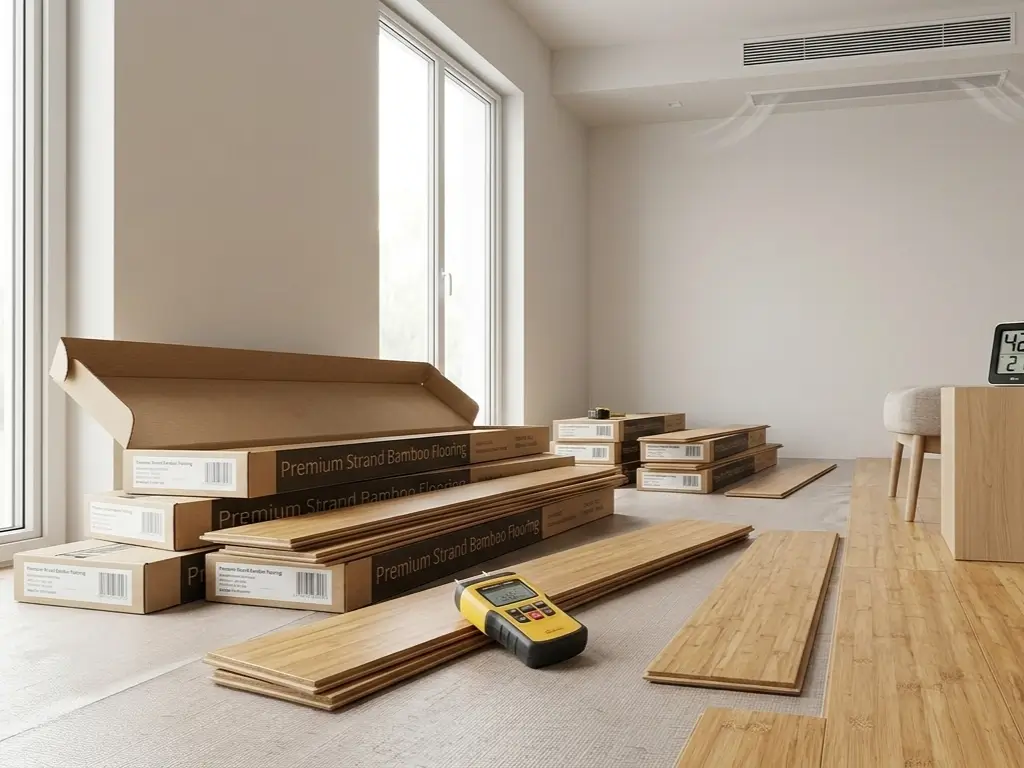
After installing bamboo in 14 rooms across four homes since 2017, I’ve learned that time-based acclimation rules are unreliable. Moisture meter readings are what actually predict success or failure. Here’s everything I’ve documented about getting acclimation right, including the expensive lessons from getting it wrong.
How Long Does Bamboo Flooring Need to Acclimate?
Direct answer: Most bamboo flooring requires 5-14 days of acclimation, though the actual timeline depends on three factors: bamboo type, your home’s humidity levels, and how different the storage conditions were from your installation space.
Here’s what I’ve documented across my installations:
| Bamboo Type | Typical Acclimation | My Observed Range | Key Factor |
| Engineered bamboo | 3-5 days | 3-7 days | Core provides stability |
| Solid horizontal/vertical | 5-10 days | 5-12 days | Full bamboo, more reactive |
| Strand-woven bamboo | 7-14 days | 8-14 days | Dense compressed fibers |
Applies when: Home HVAC has been running normally for 2+ weeks, maintaining 35-55% relative humidity
Source: National Wood Flooring Association Installation Guidelines, 2023
The numbers on the box? They’re minimums for ideal conditions. When I installed strand-woven bamboo in my basement in February 2021, the manufacturer said 7 days. My moisture meter showed the planks weren’t at equilibrium until day 12. That extra patience likely saved the floor.
For guidance on other bamboo flooring installation considerations, from underlayment selection to expansion gaps, that resource covers the full process.
Why Acclimation Time Varies by Bamboo Type
Not all bamboo flooring absorbs and releases moisture at the same rate. Understanding why saved me from a costly mistake in 2019.
Strand-woven bamboo (also called compressed bamboo or fossilized bamboo) is manufactured by shredding bamboo fibers, saturating them with adhesive, and compressing them under extreme pressure. This creates a product with a Janka hardness rating of 3,000-5,000 lbf, but it also means moisture must penetrate a denser material structure. In my testing, strand-woven planks from Cali Bamboo took 11 days to reach the same moisture content as my subfloor, despite the box recommending 7.
Solid bamboo flooring (horizontal or vertical grain) uses full bamboo strips laminated together. It’s less dense than strand-woven, so it responds faster to humidity changes, which means it acclimates quicker but is also more likely to expand and contract seasonally. My solid horizontal install in a sunroom needed 8 days initially but continues to show 1/16″ seasonal movement six years later.
Engineered bamboo flooring has a bamboo wear layer bonded to a plywood or HDF core. The core provides dimensional stability, which is why engineered products genuinely can acclimate in 3-5 days for most installations. The trade-off: you’re getting less actual bamboo in the product.
The climate and humidity considerations matter more than most installers acknowledge, particularly if you live somewhere with dramatic seasonal humidity swings.
The “3-Day Rule” Almost Ruined My Kitchen Floor
MYTH: “Bamboo flooring needs 3 days to acclimate, just like the box says.”
REALITY: Three days is a minimum for ideal conditions, not a universal rule. Actual acclimation depends on moisture content reaching equilibrium, which varies by product density, humidity differential, and seasonal conditions.
In March 2019, I installed strand-woven bamboo in my kitchen. The box said 72 hours. The installer (a licensed contractor) said that was sufficient. I trusted both.
By October, the floor had developed visible gaps between planks, some nearly 1/8″ wide. The culprit wasn’t humidity damage after installation. The floor never properly acclimated in the first place. Those March conditions (45% humidity, planks stored in my attached garage at 55% humidity) meant the bamboo needed far longer than three days to reach equilibrium with my kitchen’s 38% winter humidity.
Why the confusion exists: Manufacturers list minimum acclimation times to avoid overwhelming consumers. “7-14 days” sounds intimidating on packaging. “72 hours” sounds manageable. But the physics don’t care about marketing.
What I do now: I ignore the box. I trust my moisture meter. The planks aren’t ready until they’re within 2-4% moisture content of my subfloor, period. That approach has prevented any repeat failures across my subsequent nine installations.
For what happens when acclimation goes wrong, the bamboo flooring gaps guide documents both causes and repair options.
How to Measure Acclimation Properly (Not Just Wait)
Waiting a specific number of days is the amateur approach. Measuring moisture content is how professionals verify acclimation. Here’s the protocol I use:
Step 1: Test your subfloor first
Before your bamboo even arrives, establish baseline moisture readings. For concrete subfloors, ASTM F2170 testing (relative humidity probes) is the standard, concrete should read below 75% RH, or below 80% RH if you’re using a moisture-mitigating underlayment. For plywood subfloors, pin moisture meters work fine; target below 12% moisture content.
Step 2: Test bamboo planks from multiple boxes
Don’t test just one box. I test 3-4 planks from boxes at different positions in the delivery stack. Top boxes may have different readings than bottom boxes (compression affects moisture movement). Record every reading.
Step 3: Compare the differential
The NWFA standard: bamboo moisture content should be within 2-4% of wood subfloor moisture content. For concrete, you’re measuring RH instead, but the principle holds. If your planks read 9% MC and your plywood subfloor reads 11% MC, you’re within tolerance.
Step 4: Retest every 2-3 days
Document readings over time. You’re looking for stabilization, not just a single good reading. When readings stay consistent for 3-4 days, the bamboo has reached equilibrium.
My tool recommendation: I use both a pin-type meter (Delmhorst BD-2100) for precise plank readings and a pinless meter (Wagner Orion 950) for quick subfloor scanning. The pinless doesn’t leave holes in your flooring, which matters if you’re testing finished planks.
Seasonal Timing: When Acclimation Gets Complicated
Here’s what nobody told me before my first winter installation: your home’s humidity isn’t constant throughout the year, and acclimating bamboo during one season means it’s reaching equilibrium with conditions that won’t exist in six months.
Winter installations (heating season):
Indoor humidity drops significantly, often to 25-35% in cold climates. If you acclimate and install during this period, the bamboo reaches equilibrium at a contracted state. Come summer, when humidity rises to 50-60%, those planks will expand. The bamboo flooring warping guide covers what this expansion looks like when there’s not enough expansion gap.
Summer installations:
The opposite problem. Bamboo acclimates at an expanded state, then contracts through winter. This is why my March-installed kitchen floor developed gaps, the planks reached equilibrium at moderate-high humidity, then shrank when heating season arrived.
My approach now:
For installations in extreme humidity seasons, I try to acclimate closer to mid-range conditions. That means running a dehumidifier during summer acclimation (targeting 45-50% RH) or running a humidifier during winter acclimation (targeting 40-45% RH). The goal is acclimating to “average” annual conditions, not the seasonal extreme.
This adds complexity, but it’s prevented the seasonal movement issues I saw in my earlier installations.
What Happens When You Skip Acclimation
I’ve seen three failure modes from rushed or skipped acclimation:
Cupping (edges higher than center): This happens when the bottom of planks absorbs moisture faster than the top. If bamboo goes down before reaching equilibrium with subfloor moisture, the underside continues absorbing after installation. My basement install would have cupped badly if I’d followed the 7-day recommendation, the subfloor was reading 13% MC while the planks were at 8% MC on day 7.
Gapping (visible spaces between planks): The opposite problem. Planks installed while moisture-expanded will shrink as they reach equilibrium with drier conditions. This is cosmetic at first but collects debris over time and can indicate a floor that will continue moving seasonally.
Buckling (planks lifting from subfloor): The worst outcome. Severe expansion with no room to move forces planks upward. I’ve only seen this once, a neighbor’s install where strand-woven bamboo was installed same-day delivery with zero acclimation. The floor buckled within three months.
The common bamboo flooring problems resource covers diagnosis and remediation for each of these failures.
Same Product, Different Conditions
Acclimation Time Variation
Product Entity: Cali Bamboo Fossilized Wide Click (strand-woven, 5.125″ wide)
Setup: Same product installed in two rooms, main floor living room (February 2022) and basement (March 2022). Approximately $3,800 materials per room.
Expected (manufacturer): 7 days minimum acclimation
Actual:
- Living room: Reached equilibrium in 9 days (started at 7.2% MC, subfloor at 10.1% MC, stabilized at 9.4% MC)
- Basement: Reached equilibrium in 13 days (started at 6.8% MC, subfloor at 12.4% MC, stabilized at 11.2% MC)
Surprise: Same product, same manufacturer, but 4 days difference in acclimation time due to the moisture differential between storage conditions and installation space. The basement’s higher subfloor moisture meant the bamboo had to absorb more moisture to reach equilibrium.
Limitation: This is two rooms, not a controlled study. But it demonstrates why time-based rules fail, the variables matter more than a calendar.
FAQ: Bamboo Flooring Acclimation
Can I leave bamboo flooring in the garage to acclimate?
No, the whole point is acclimating to your installation space conditions. Garages have different temperature and humidity than living spaces. I made this mistake in 2018, leaving boxes in an attached garage for a week before moving them inside. The planks needed another 6 days to adjust once they were actually in my living room. Bring boxes directly into the room where they’ll be installed, with HVAC running normally.
Should I open the boxes or leave them sealed during acclimation?
Open them. I’ve tested both approaches, and opened boxes with planks loosely stacked (not cross-stacked) acclimated 2-3 days faster than sealed boxes. Air circulation matters. The NWFA recommends removing planks from boxes entirely for optimal air exposure, though I typically just open boxes and separate the top planks.
Does strand-woven bamboo need longer to acclimate than regular bamboo?
Yes. Strand-woven bamboo’s compressed fiber structure means moisture penetrates more slowly. In my experience, strand-woven needs 8-14 days versus 5-10 days for solid bamboo or 3-7 days for engineered bamboo. The trade-off is that strand-woven is also less reactive once installed, it handles humidity swings better than solid bamboo over time.
Can I shorten acclimation if my home has stable humidity?
Only if moisture readings confirm equilibrium. If your home maintains consistent 40-45% RH year-round and your subfloor and bamboo readings are within 2-4% MC on day 5, you’re technically ready. But I’d still wait until readings stabilize for 2-3 consecutive measurement days. The $50-100 cost of a moisture meter is nothing compared to replacing a failed floor.
What humidity level is ideal during acclimation?
Target 35-55% relative humidity, the same range recommended for long-term bamboo floor maintenance. If your home falls outside this range, address it before installation. A whole-house humidifier or dehumidifier is a worthwhile investment; my Aprilaire unit paid for itself by preventing the humidity swings that damaged my earlier floors.
Getting Acclimation Right the First Time
The difference between a 25-year bamboo floor and a 5-year failure often comes down to these pre-installation days. I’ve learned that the hard way.
My position now: treat manufacturer acclimation times as minimums, not targets. Invest in a moisture meter. Test subfloor and planks. Wait for equilibrium, not a calendar date. If you’re installing strand-woven bamboo, budget at least two weeks of acclimation into your project timeline.
If I were starting my first bamboo floor project over, I’d buy the moisture meter before the flooring. That $80 investment would have saved me $4,200 in replaced kitchen flooring.
For the actual installation process once acclimation is complete, the full bamboo flooring installation guide covers methods, tools, and the mistakes I wish I’d avoided.